
A force gauge, also widely known as apush pull force gauge, is a portable precision measuring instrument designed to quantify tensile and compressive force in physical mechanical testing. Unlike ordinary handheld tools that rely on subjective manual judgment, a professional force gauge delivers repeatable, accurate, and data-backed force readings, making it a foundational device for quality control, product R&D, and industrial performance verification across global manufacturing sectors. As industrial quality standards become stricter, digital force gauge solutions have gradually replaced traditional manual testing, becoming the standard tool for standardized mechanical performance inspection.
How Does a Force Gauge Work? Core Measurement Principle
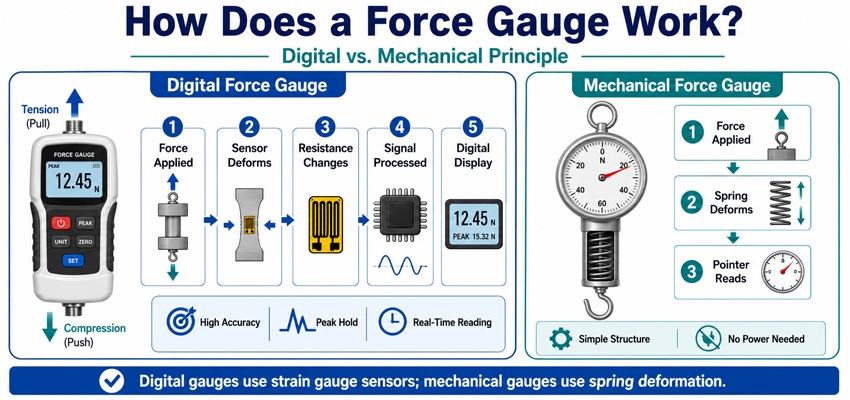
To understand what a force gauge is, it is essential to master its core working logic, which differentiates it from common measuring tools such as spring scales and pressure testers. The mainstream digital force gauge adopts the mature strain gauge sensor measurement principle. Built-in high-sensitivity strain gauge sensors deform slightly when subjected to tension or compression force. The deformation changes the internal resistance value, which is converted into a measurable electrical signal through the Wheatstone bridge circuit. After amplification, filtering, and digital calculation by the internal chip, the accurate force value is finally output and displayed in real time. For traditional mechanical force gauges, the working principle follows Hooke’s Law. It uses spring elastic deformation to drive the pointer for mechanical reading, featuring simple structure and no power supply required. However, it is limited by manual visual observation, resulting in low precision and no data storage function, which is only suitable for simple on-site screening. The most core technical advantage of professional force gauge measurement is peak value locking and real-time dynamic monitoring. It can instantly capture the maximum force generated at the moment of product fracture, separation, or deformation, which cannot be realized by ordinary simple measuring tools.
Main Types of Force Gauges
Force gauges are mainly divided into two categories according to structural form and technical configuration, covering different industrial testing budgets and precision requirements:
Mechanical Force Gauge
This analogue push pull force gauge relies on spring mechanical transmission for force display. It requires no battery or power supply, features stable performance and low maintenance cost, and is suitable for harsh industrial environments and daily batch preliminary testing. Its disadvantages are obvious: single measurement mode, no data recording function, and low test accuracy, which cannot meet high-standard industrial inspection and experimental data traceability requirements.
Digital Force Gauge
As the mainstream upgraded model in the current market, the digital force gauge integrates high-precision sensors and intelligent data processing systems. It supports real-time force display, peak value locking, multi-unit switching, and mass data storage and export. With higher test accuracy, stronger anti-interference ability, and more intuitive operation, it is the preferred equipment for formal quality inspection, laboratory testing, and product process optimization.
Core Functions of a Standard Force Gauge
Professional industrial force gauges focus on practical and standardized force detection, with core functions covering all conventional mechanical testing scenarios:
- Dual tension and compression testing: Compatible with pull force and push force detection, covering most product mechanical performance tests such as stretching, pressing, inserting, and extracting.
- Real-time and peak dual modes: Real-time mode tracks continuous force changes dynamically; peak mode locks the maximum bearing force of the test piece, effectively capturing instantaneous failure force values.
- Multi-unit conversion: Freely switch between Newton (N), kilogram-force (kgf), pound-force (lbf) and other international common units to meet the testing standards of different industries and regions.
- Data recording and traceability: The digital model stores multiple groups of test data, supports data export and report generation, solves the problem of messy manual records, and provides effective data support for quality filing and process improvement.
Key Industrial Force Gauge Applications
Force gauge applications cover almost all manufacturing industries that require mechanical performance testing, running through the entire process of product R&D, production assembly, and finished product inspection:
Electronics and Hardware Manufacturing
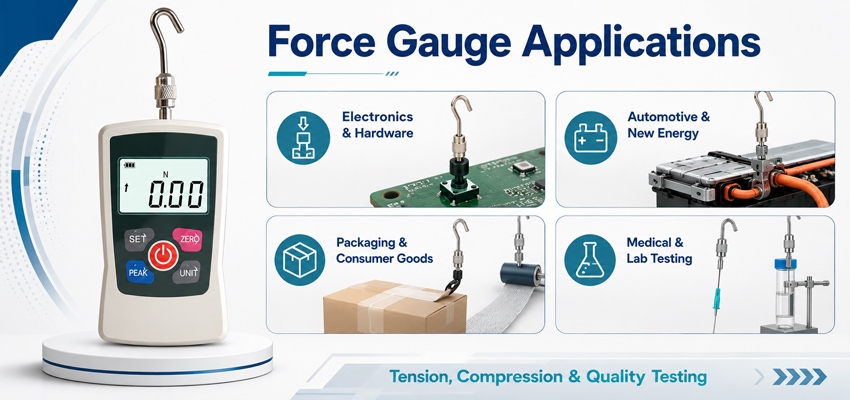
It is used for testing the insertion and extraction force of precision electronic connectors, the pressing force of keyboard and touch switches, the opening and closing tension of plastic buckles and hardware fasteners, and the elastic fatigue test of small springs. It helps manufacturers unify assembly standards and avoid product failure caused by excessive or insufficient tightness.
Automotive and New Energy Industry
In the automotive field, force gauges test the fixing tension of internal wire harnesses, the compression resistance of interior damping parts, and the clamping force of new energy battery modules. All tests ensure that auto parts can resist mechanical vibration and extrusion during vehicle operation, meeting automotive safety and durability standards.
Packaging and Consumer Goods Industry
It detects the opening force of plastic packaging bags, the sealing tension of cartons, the tensile strength of textile fabrics, and the force of daily necessities accessories. It is widely used to verify product assembly firmness and packaging safety, optimizing user experience and transportation durability.
Medical Devices and Laboratory Research
Medical-grade force gauges test the tensile and compression resistance of medical catheters and disposable consumables to ensure clinical safety. In university and enterprise laboratories, they are used for mechanical property testing of new materials, providing accurate and repeatable experimental data for material formula optimization and structural design iteration.
Why Industrial Factories Need Professional Force Gauges
Many small and medium-sized manufacturing enterprises used to rely on manual feel for force testing, which leads to inconsistent test results, no data retention, and difficult quality tracing. A standard force gauge standardizes the entire testing process, eliminates human subjective errors, and provides quantifiable, comparable, and storable test data. For enterprises, popularizing push pull force gauge testing can effectively reduce defective product rate, unify production process standards, improve product market competitiveness, and meet the audit requirements of international customers for production quality control systems.
FAQ About Force Gauges
1. What does a force gauge measure?
A force gauge accurately measures static and dynamic tension and compression force values, covering various mechanical forces such as insertion force, pulling force, pressing force, and breaking force involved in industrial testing.
2. What is the difference between a force gauge and a torque meter?
A force gauge tests linear push and pull force, while a torque meter tests rotational torsion force. The two are completely different testing tools and cannot replace each other in industrial scenarios.
3. Is a digital force gauge better than a mechanical one?
Digital force gauges have obvious advantages in precision, data traceability and functional diversity, suitable for formal quality inspection and experimental scenarios. Mechanical force gauges are more suitable for simple on-site screening with low budget and low precision requirements.