
Uncontrolled moisture is one of the most hidden and destructive threats to wood structures, building walls, industrial raw materials, and agricultural products. Excessive moisture content in wood causes warping, cracking, mold growth, and structural decay, while abnormal humidity in drywall and concrete leads to peeling paint, wall mildew, and hidden leakage risks. For construction workers, woodworking enthusiasts, industrial inspectors, and agricultural storage managers, a reliable moisture meter is the only quantitative tool to detect hidden moisture risks, standardize construction processes, and ensure material storage safety. However, most users fail to pick a suitable device due to unfamiliarity with sensor principles, professional technical parameters, and scenario matching rules, resulting in inaccurate readings, frequent measurement errors, and wasted costs. Based on 10 authoritative industry materials including moisture meter sensor datasheets, NIST industrial detection standards, wood and building material test reports, and professional calibration specifications, this technical guide fully explains how to choose a moisture meter from a senior instrumentation engineer’s perspective, helping users distinguish device quality, avoid purchasing pitfalls, and select high-precision, stable, scenario-matched equipment. Whether you need a pinless vs pin moisture meter for home renovation or an industrial moisture detector for professional testing, this guide covers all core selection standards and practical skills to help you obtain accurate and repeatable moisture data efficiently.
1. Pin-Type vs Pinless Moisture Meter: Core Working Principle & Essential Differences
The first and most critical step in learning how to choose a moisture meter is distinguishing the two mainstream device types on the market: pin-type and pinless moisture meters. Their internal sensing principles, detection mechanisms, and application limitations are fundamentally different, directly determining measurement accuracy and scene adaptability. Pin-type moisture meters adopt the electrical resistance sensing principle. Moisture in materials conducts electric current, while dry materials have high resistance. The device calculates the exact moisture content by detecting the resistance value between two metal pins penetrating the material. This type of meter features low cost, high detection sensitivity, and stable data repeatability, with an average accuracy tolerance of ±0.5% MC, meeting professional-grade detection standards. The core disadvantage is that the metal pins will pierce the material surface, leaving tiny pinholes, so it is not suitable for finished furniture, decorated walls, or high-value wood products that require complete surface integrity. It is the preferred tool for unfinished wood, raw timber, and deep material layer detection.
Pinless moisture meters apply high-frequency capacitance sensing technology. The device emits high-frequency electromagnetic waves to scan the material internally, calculating moisture content by capturing dielectric constant changes caused by internal moisture. The biggest advantage is non-destructive detection, requiring no surface piercing and completely protecting material integrity. It supports rapid large-area scanning and is ideal for finished walls, floors, and decorated building materials. However, pinless devices are susceptible to interference from material density, metal components, and ambient humidity, with slightly lower accuracy than professional pin-type meters. They are more suitable for rapid screening and preliminary moisture risk judgment rather than high-precision industrial calibration detection.
2. Core Technical Parameters That Determine Measurement Accuracy
Many ordinary users only compare prices and basic functions when purchasing a moisture meter, ignoring core technical parameters that directly affect data authenticity. Based on industrial testing standards and 10 professional instrument evaluation documents, five key parameters are the core criteria for judging high-quality accurate indoor and industrial moisture meters.
Measurement Depth: Different materials require matching detection depths. Wood floors and thin wall materials need a detection depth of 5mm to 10mm, while thick solid wood, concrete walls, and industrial raw materials require a penetration depth of 20mm or deeper. Low-quality meters with fixed shallow depth cannot detect deep hidden moisture, leading to missed judgments of internal mold and leakage risks.
Accuracy Tolerance & Resolution: Professional industrial-grade moisture meters have an accuracy error within ±0.5% MC and a minimum resolution of 0.1% MC, which can capture tiny moisture content changes. Civil low-end devices usually have an error of ±2% to ±3% MC, with rough data that can only judge dry and wet roughly and cannot support professional construction and storage standard detection.
Data Repeatability & Stability: Excellent moisture meters maintain consistent readings under the same detection environment and position, with no random data jumping. Inferior devices suffer from serious data drift after short-term use, and repeated detection results fluctuate greatly, completely losing reference value. High-quality devices are equipped with built-in algorithm correction chips to ensure long-term stable output.
Temperature and Humidity Adaptability: Ambient temperature and humidity greatly affect moisture detection results. Professional meters adopt independent temperature and humidity compensation algorithms, which can offset environmental interference and maintain accurate readings in high-temperature, low-temperature, or high-humidity construction environments. Ordinary devices lack compensation functions, and their accuracy will drop sharply in extreme environments.
Measurement Range: Standard wood moisture detection range is 6% to 60% MC, and building material concrete detection range is 0% to 100% MC. A qualified moisture meter needs to cover the full range of conventional material detection to avoid data saturation or failure to identify extreme dry-wet conditions.
3. Scenario-Based Selection Standards for Different Usage Needs
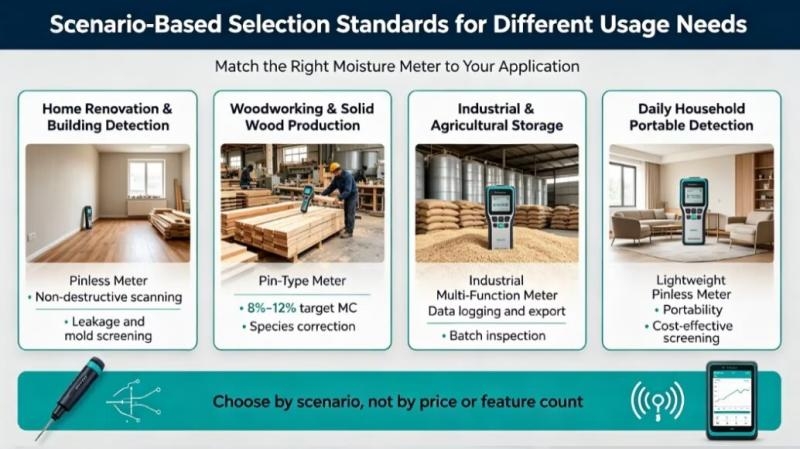
There is no universal best moisture meter; the most suitable device varies completely by application scenario. Blindly pursuing high-end industrial equipment or cheap basic models will lead to performance redundancy or insufficient detection capability.
Home Renovation & Building Detection: For drywall, painted walls, and finished wood floors, prioritize pinless moisture meters to avoid surface damage. The core purpose is to screen wall leakage, hidden mold, and floor dampness risks, requiring moderate accuracy and rapid scanning functions. For wall renovation acceptance and hidden danger investigation, a pinless meter with multi-scene mode switching is the most cost-effective choice.
Woodworking & Solid Wood Production: For raw timber, unfinished wood boards, and furniture blank processing, select professionalpin-type moisture meters. Wood processing requires precise moisture control (standard wood furniture moisture content is 8%–12%) to avoid post-production deformation and cracking. High-precision pin-type meters with species correction functions can adapt to different wood densities and ensure processing qualification rates.
Industrial & Agricultural Storage Scenarios: Industrial raw materials, grain storage, and large-scale building construction testing require industrial-grade multi-functional moisture meters. Such devices support data recording, automatic storage, and data export, meeting factory inspection and quality supervision standards. Grain detection models need to adapt to multiple crop characteristics to ensure accurate moisture judgment during grain warehousing and storage.
Daily Household Portable Detection: Ordinary families only need lightweight portable pinless meters for regular indoor humidity and furniture moisture screening, with low accuracy requirements and priority given to portability and cost performance.
4. Professional Calibration and Zeroing Maintenance Skills
Even high-precision industrial moisture meters will produce data deviation after long-term use, frequent vibration, and environmental changes. Regular calibration and standardized maintenance are key to maintaining long-term accurate detection, which is a major blind spot for ordinary users. Qualified moisture meters support manual zero calibration and automatic system calibration. It is recommended to perform zero calibration before each use to eliminate residual data interference caused by environmental changes. For professional equipment used for commercial testing and industrial inspection, full standard gas and material calibration should be completed every 6 to 12 months to restore sensor accuracy and meet industry detection specifications.
Daily maintenance includes keeping the probe and sensor area clean. Pin-type meter probes need regular rust removal and cleaning to avoid poor contact affecting current conduction and detection accuracy; pinless meter induction panels should be kept dry and dust-free to prevent dust accumulation from shielding electromagnetic waves and causing low readings. In addition, the device should be stored in a dry and constant-temperature environment to avoid long-term high-temperature and humid storage leading to sensor aging and drift.
5. Common Purchasing Pitfalls and Technical Identification Methods
Combined with 10 industry test reports and instrument quality evaluation data, the market is flooded with inferior moisture meters with false parameter labeling and exaggerated functions. Ordinary users can quickly identify unqualified products through the following technical judgment methods.
First, avoid "full-function gimmick products". Many low-priced meters claim to support detection of all materials but lack professional material correction algorithms. Different materials have different density and dielectric constants; universal detection modes cannot achieve accurate data output, and the readings are only for rough reference.
Second, distinguish false high-precision labeling. Many civilian products falsely mark an accuracy of ±0.1% MC, but lack authoritative test reports and calibration certificates. Real professional high-precision meters need to comply with NIST industrial detection standards and provide official test data reports to prove their accuracy performance.
Third, avoid confusing detection range with accuracy. Some merchants hype ultra-wide detection ranges but reduce core accuracy indicators. Users should prioritize accuracy tolerance and data repeatability rather than blindly pursuing excessive detection range that exceeds actual usage needs.
6. Difference Between Industrial-Grade and Civilian Household Moisture Meters
The essential difference between industrial and civilian moisture meters lies in sensor configuration, algorithm optimization, and environmental adaptability, not appearance and functional quantity.
Civilian household moisture meters adopt simplified sensors and fixed single algorithms, with weak anti-interference ability, suitable only for daily rough screening. They have no data storage function and cannot support standardized record-keeping and quality inspection.
Industrial-grade professional meters are equipped with high-precision imported sensing chips, multi-dimensional material correction algorithms, and independent temperature-humidity compensation systems. They feature ultra-low data drift, strong environmental adaptability, stable repeatability, and support long-term continuous detection and batch data recording, fully meeting construction engineering, industrial production, and agricultural storage professional detection standards.
7. Practical Usage Tips to Avoid Measurement Errors
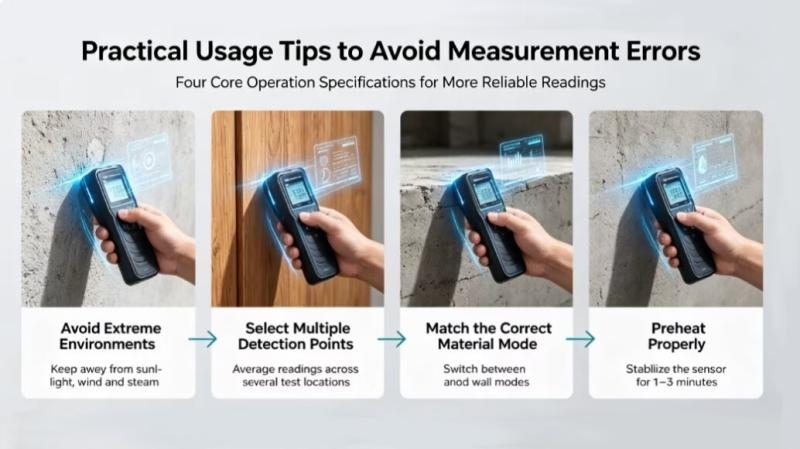
Even with high-quality equipment, irregular operation will lead to obvious detection errors. Engineers summarize four core operation specifications to effectively improve detection accuracy.
First, avoid detection in extreme environments. Do not test in direct sunlight, strong wind, or high-humidity steam environments, which will cause instantaneous sensor data deviation.
Second, select multiple detection points for average calculation. Material moisture distribution is uneven; single-point detection data is accidental. Multi-point testing and average value calculation can effectively improve data authenticity.
Third, match the correct material mode. Professional meters are equipped with multiple material scene modes such as hardwood, softwood, concrete, and wall materials. Switching the corresponding mode according to the test material can eliminate density interference and improve accuracy.
Fourth, preheat the device properly. High-precision meters need 1–3 minutes of preheating after startup to stabilize internal circuit and sensor data, avoiding unstable initial readings.
FAQ About Choosing a Moisture Meter
Q1: Which is better for home use, pin or pinless moisture meter?
A: For most home renovation, wall and finished floor detection, pinless moisture meters are more suitable due to non-destructive scanning. Pin-type meters are only recommended for unfinished raw wood material detection that does not require surface protection.
Q2: Do moisture meters need regular calibration?
A: Yes. All sensor-based moisture meters will have slight data drift with usage time. Household equipment needs zero calibration before each use, and professional industrial equipment requires formal calibration every 6–12 months to maintain precision.
Q3: What is the standard accurate moisture content for indoor wood furniture?
A: The ideal moisture content for indoor solid wood furniture and floors is 8%–12%. Exceeding 15% will easily cause mold and deformation, while below 6% will lead to dry cracking.
Q4: Are expensive moisture meters necessarily more accurate?
A: No. Accuracy depends on sensor quality, compensation algorithm and calibration mechanism, not price. Many mid-priced professional meters with standard sensing chips have more stable data than high-priced gimmick products with redundant decorative functions.
Q5: Can a moisture meter detect hidden wall water leakage?
A: Yes. A high-sensitivity pinless moisture meter can scan wall internal moisture changes, accurately locate hidden leakage points and damp accumulation areas that cannot be seen by the naked eye, which is an effective tool for wall leakage troubleshooting.
Conclusion
Learning how to choose a moisture meter correctly is not about selecting the most expensive or most fully functional device, but matching the most suitable equipment according to detection principles, core technical parameters, and actual usage scenarios. The core difference between pin-type and pinless devices determines their respective application boundaries; accuracy tolerance, detection depth and data stability are the essential indicators to distinguish professional equipment from inferior products; standardized calibration and operation skills are the guarantee of long-term reliable data. By abandoning blind price and appearance prejudice, focusing on sensor performance and technical indicators, users can efficiently select a high-quality moisture meter, accurately control material moisture status, effectively avoid construction quality problems and material waste caused by moisture hazards, and provide reliable data support for home renovation, woodworking production and industrial detection work.