
Indoor air quality directly impacts human respiratory health, sleep quality, and long-term physical condition. According to EPA indoor air quality assessment data, indoor air pollutants such as PM2.5, formaldehyde (HCHO), and TVOC can be 2 to 5 times more concentrated than outdoor pollutants, especially in newly renovated houses, closed offices, and pet households. An accurate indoor air quality monitor serves as the core tool to quantify air quality data, identify pollution sources, and guide ventilation and purification operations. However, countless ordinary users fall into purchasing traps due to unfamiliarity with sensor technologies and technical parameters, resulting in inaccurate detection data and idle monitoring devices. This professional air quality monitor buying guide, based on 18 authoritative industry documents including sensor datasheets, EPA monitoring standards, and third-party IAQ test reports, will explain how to choose an air quality monitor from a senior IoT sensor engineer’s perspective, helping users screen high-precision, stable, and scenario-matched monitoring equipment and avoid gimmick products.
1. Master Core Sensor Technologies: The Foundation of Monitoring Accuracy
The core component that determines the quality of an air quality monitor is the built-in sensor. Most low-cost civilian monitors on the market adopt simplified sensor modules, while high-precision professional equipment is equipped with industrial-grade sensing chips. The differences in technical principles directly lead to gaps in detection accuracy and stability. The three mainstream sensor technologies in the industry are laser scattering, NDIR non-dispersive infrared, and electrochemical sensing, each with unique applicable scenarios and performance advantages.
Laser scattering sensors are mainly used for PM2.5 and PM10 particle detection. This technology calculates particle concentration by detecting the light scattering intensity of suspended particles in the air, featuring fast response speed and high real-time data refresh rate. Qualified laser sensors can identify particle changes within 1 second, making them suitable for real-time monitoring of indoor dust and haze pollution. However, low-quality laser modules are susceptible to interference from humidity and tiny water mist, leading to data floating.
NDIR infrared sensors are the mainstream solution for CO2 concentration detection. Compared with traditional chemical sensors, NDIR technology has no chemical attenuation, ultra-long service life, and strong anti-interference ability. It relies on the selective absorption characteristics of carbon dioxide for infrared light to complete concentration calculation, with detection accuracy up to ±50ppm, fully meeting indoor daily monitoring and commercial office scenario needs.
Electrochemical sensors are exclusively used for toxic and harmful gas detection such as HCHO and TVOC. This technology realizes gas concentration quantification through chemical reaction current conversion. Professional electrochemical sensors adopt dual-electrode and temperature compensation design, which can offset the interference of ambient temperature and humidity on detection results. In contrast, inferior semiconductor sensors used in cheap monitors have serious data drift and cannot accurately detect low-concentration formaldehyde released slowly from decoration materials.
2. Select Matching Detection Parameters Based on Usage Scenarios
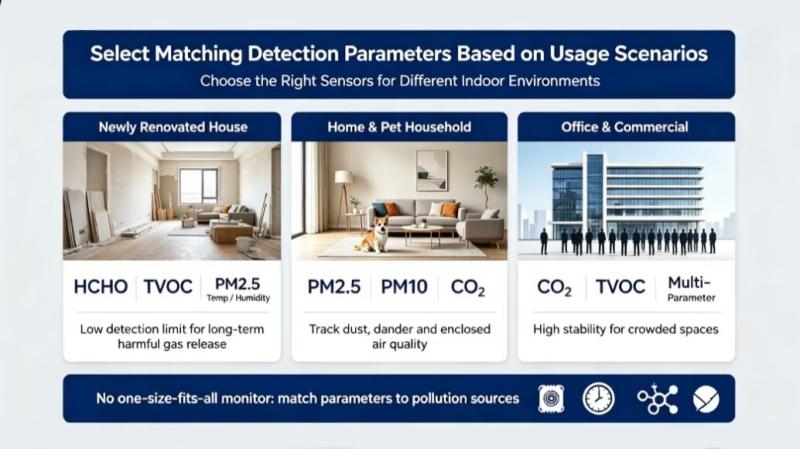
There is no one-size-fits-all air quality monitor. Different living and working scenarios have completely different pollution sources, and targeted parameter selection is the key to practical monitoring. Blindly purchasing full-parameter monitors or single-function devices will lead to insufficient monitoring capabilities or wasted functions.
For newly renovated houses, formaldehyde and TVOC are the primary monitoring indicators. Decoration materials such as plates, paint, and adhesives will continuously release harmful gases for 3 to 15 years. It is necessary to select an air quality monitor with high-precision electrochemical HCHO and TVOC sensors, with a low detection limit capable of capturing ultra-low concentration harmful gas changes. PM2.5 and temperature and humidity parameters can be used as auxiliary monitoring items to comprehensively judge indoor environmental quality.
For daily home use and pet households, PM2.5, PM10, and CO2 are the core monitoring parameters. Pet dander, floating dust, and outdoor haze invasion are the main indoor pollutants. At the same time, closed home spaces with long-term human activities will cause continuous CO2 accumulation, leading to stuffiness and drowsiness. A monitor with laser particle detection and NDIR carbon dioxide monitoring functions can effectively track air quality changes and guide timely ventilation.
For office and commercial scenarios, multi-parameter integrated monitoring is required. Crowded office spaces have high CO2 emission density, while office equipment and decorative materials will produce trace TVOC pollutants. Industrial scenarios need to upgrade to explosion-proof and high-stability monitoring equipment, with enhanced anti-dust and high-temperature resistance functions to adapt to complex industrial environments.
3. Core Technical Indicators to Judge Monitor Quality
Ordinary users often only pay attention to product appearance and price, while professional engineers judge monitor performance through four core technical indicators: detection limit, response speed, data stability, and anti-interference ability. These indicators determine the authenticity and reference value of monitoring data.
The detection limit refers to the minimum gas concentration that the monitor can accurately identify. For formaldehyde monitoring, the professional detection limit should reach 0.01mg/m³, which can capture trace harmful gases that exceed the standard slightly. Low-precision equipment can only identify high-concentration formaldehyde, which cannot meet the safety monitoring needs of daily living environments. Response speed reflects the real-time performance of the device. Excellent air quality monitors can complete data update within 1 to 3 seconds and track sudden changes in air quality in real time. Slow-response equipment will cause data lag, unable to timely capture instantaneous pollution peaks such as cooking fume and outdoor haze intrusion.
Data stability is the core standard to distinguish civilian and professional equipment. High-quality monitors adopt algorithm correction and regular calibration mechanisms, with almost no data drift in long-term use. Inferior products will have serious data deviation after 1 to 2 months of use, losing monitoring significance. In addition, professional equipment has independent temperature and humidity compensation algorithms, which can resist the interference of extreme ambient temperature and humidity on detection data.
4. Smart Function and Data Transmission Practicality Evaluation
With the popularization of smart home technology, most air quality monitors on the market are equipped with smart linkage functions, but many functions are marketing gimmicks with no practical value. From a professional perspective, users need to screen practical smart functions and avoid paying for useless configurations.
Effective smart functions include real-time cloud data synchronization, mobile APP remote viewing, and air quality trend recording. The cloud monitoring function can store historical monitoring data for more than 30 days, forming daily and weekly air quality change curves, which helps users summarize pollution rules and formulate scientific ventilation and purification plans. Remote APP viewing is very suitable for newly renovated houses, allowing users to remotely check indoor air quality changes in real time.
Low-power design is also a key practical indicator. Portable air quality monitors with low-power chips can achieve long battery life, avoiding frequent charging troubles. For fixed indoor monitoring equipment, wired power supply with battery backup function can ensure continuous monitoring even in case of sudden power failure. It is worth noting that functions such as colorful ambient lights and voice broadcast of single data are pure gimmicks, which will not improve monitoring performance but will increase product costs and power consumption. Users can give priority to functional practicality over redundant decorative configurations.
5. Equipment Calibration and Later Maintenance Guidelines
Even high-precision industrial-grade air quality monitors will have slight data drift after long-term use. Regular calibration and standardized maintenance are essential to ensure long-term accurate detection, which is a key point ignored by most ordinary users.
Professional monitors support manual calibration and automatic algorithm calibration. It is recommended to perform zero calibration every 3 months and full-scale calibration every 12 months. Zero calibration is suitable for daily maintenance, which can eliminate data deviation caused by environmental dust accumulation; full-scale calibration needs to be completed with standard gas to restore the highest detection accuracy of the sensor.
Daily maintenance mainly includes regular dust cleaning of the sensor air inlet. Long-term accumulation of dust will block the air intake channel, affect gas circulation, and lead to low detection data. It is recommended to wipe the air inlet with a dry soft cloth every month and avoid placing the monitor in humid, high-temperature or direct sunlight environments for a long time to prevent sensor aging and failure.
6. Common Market Purchasing Pitfalls and Identification Methods
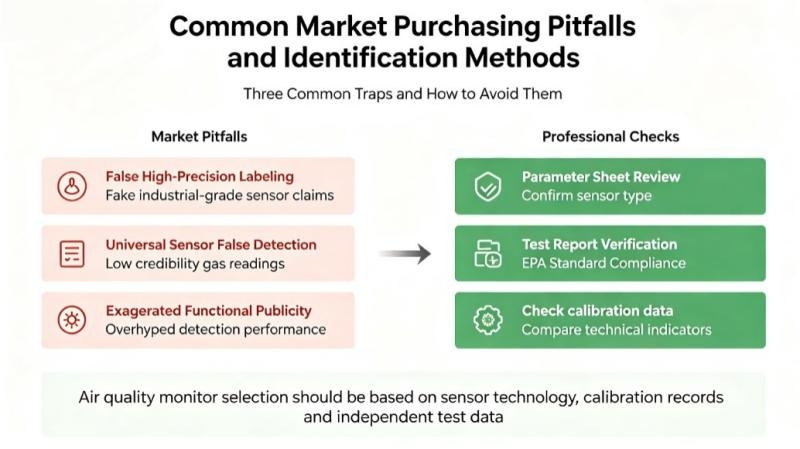
Affected by market homogenization competition, many inferior air quality monitors falsely label parameters and hype functions, confusing consumer judgment. Summarized from 18 industry test reports, the three most common purchasing pitfalls are false high-precision labeling, universal sensor false detection, and exaggerated functional publicity.
Many low-cost products claim to support full-parameter high-precision detection, but actually adopt universal semiconductor sensors. This type of sensor cannot distinguish different harmful gases and can only judge air quality roughly through gas concentration changes, with extremely low data credibility. Users can identify it through product parameter sheets: formaldehyde detection without electrochemical sensor marking is basically inferior equipment.
Some merchants exaggerate the detection range and accuracy of the equipment, falsely labeling ordinary civilian sensors as industrial-grade high-precision modules. Professional identification methods are to check whether the product has authoritative test reports and calibration certificates, and whether the detection technical indicators meet EPA indoor air quality monitoring standards.
7. FAQ About Choosing an Air Quality Monitor
Q1: Are expensive air quality monitors necessarily more accurate?
A: Not exactly. The core factor determining accuracy is the built-in sensor type and calibration algorithm, not price. Some mid-priced professional monitors with independent electrochemical and laser sensors have higher accuracy than high-priced gimmick products with redundant decorative functions.
Q2: Do home air monitors need regular calibration?
A: Yes. All sensor-based monitoring equipment will have data drift. Daily household use requires zero calibration every 3 months and professional calibration every year to ensure data accuracy.
Q3: Is a multi-parameter integrated monitor better than a single-function one?
A: It depends on the scenario. New houses need multi-parameter monitoring, while ordinary families can choose single or dual-parameter equipment according to daily pollution sources, which is more cost-effective.
Q4: Can portable air quality monitors replace fixed professional equipment?
A: Portable devices are suitable for mobile detection and temporary monitoring, with limited stability and accuracy. Long-term indoor fixed monitoring is recommended to choose wired professional fixed monitors.
Conclusion
Choosing a reliable air quality monitor is not based on price, appearance or functional quantity, but on matching sensor technology, compliant technical indicators, scenario-adapted parameters and perfect maintenance mechanisms. As analyzed in this professional buying guide, laser, NDIR and electrochemical sensors are the core guarantee of accurate monitoring; scenario-based parameter matching ensures targeted monitoring; calibration and maintenance determine the long-term service value of the equipment. By avoiding market gimmicks and focusing on essential technical performance, users can easily screen an accurate indoor air quality monitor that meets their needs, effectively monitor indoor air quality changes, and protect family and office environmental health.