
Many electricians and project buyers struggle to tell an energy meter and a power meter apart while sourcing electrical measurement tools. Search results often mix unrelated products such as bike power meters, making it harder to tell electrical meter variants apart at first glance. This confusion often leads to wrong orders, project delays, and unnecessary extra costs. In this guide, we explore why this mix-up happens, compare the two devices, review their real application scenarios, and share common buying mistakes to help you select the right energy meter for your electrical project.
1. Why Do Buyers Mix Up Energy Meter and Power Meter?
Many buyers get confused between energy meters and power meters, mainly because they both belong to electrical measuring instruments. Even experienced electrical contractors can easily mix them up when browsing product listings online.
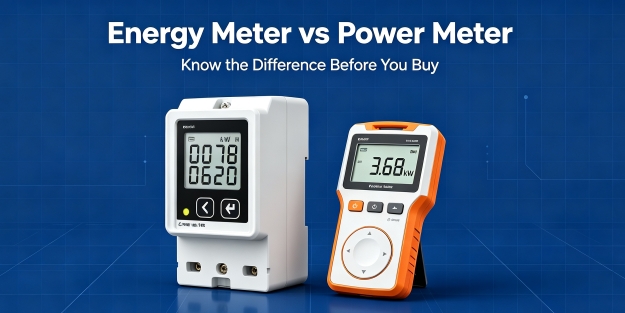
What an energy meter is
An energy meter tracks the total amount of electricity consumed over a period of time. It records cumulative power usage, and its most common unit is kWh. It is widely used for electricity billing and long-term power consumption monitoring in homes, commercial buildings, and factories. It runs continuously and keeps adding up power consumption day after day. Property owners and utility companies rely on these readings to calculate energy costs accurately.
What a power meter is
A power meter measures real-time instantaneous power load in a circuit. It reads power values in watts or kilowatts. Electrical teams use it to check circuit status, test equipment performance, and spot power anomalies. It captures power data at the exact moment you take a measurement. Technicians often use this tool for on-site inspections and fault checks during maintenance work.
Main reasons for this confusion
- Both devices collect electrical circuit data, so many product sellers use these two terms loosely in product titles and descriptions to capture more search traffic. This blurs the line between the two tools for buyers who quickly scan product pages.
- Search results include unrelated items like bike power meters. Buyers may scroll through mixed product listings and misjudge what they actually need. It is easy to click into cycling power meter products by mistake when searching for electrical testing tools.
- Some multi-function electrical meters can show both power and energy readings on one screen. This can lead buyers to think the two types of meters can fully replace each other, but they can't. Even if a meter displays both values, it is designed with one primary function, and the secondary reading may not meet official billing or high-precision testing standards.
2. Energy Meter vs Power Meter: Side-by-Side Comparison
Now we have learned the basic definition of the two meters. Let’s break down their similarities and key differences.
Similarities
- Both are electrical measuring tools used to collect circuit power data.
- Both can work for residential, commercial, and industrial electrical projects.
- Many modern models adopt digital screens to show readings clearly.
- Both need proper wiring and installation on electrical panels to get accurate readings.
Key Differences
Measurement target & unit
An energy meter records total cumulative electricity consumption over hours, days, or months, measured in kWh. A power meter captures only instantaneous power load at a single moment, with units in W or kW.
Main use purpose
Energy meters are designed for long-term consumption tracking and official electricity billing. Power meters are made for real-time circuit testing, equipment load checks, and power anomaly troubleshooting.
Working logic
Energy meters keep running and continuously add up power usage over time. Power meters only display the power value at the exact time you check, without automatic accumulation.
Response focus
An energy meter tracks total usage over a long period and does not prioritize quick power spikes. A power meter can catch sudden power changes instantly to help technicians find circuit issues.
Typical installation scenarios
Energy meters stay fixed on electrical panels for permanent monitoring. Power meters can be fixed or portable, often used for temporary inspection and equipment testing.
3. When to Use an Energy Meter
Energy meters are built for long-term power tracking and electricity recording. Pick this type of meter when you need to keep continuous records of total power use over weeks or months.
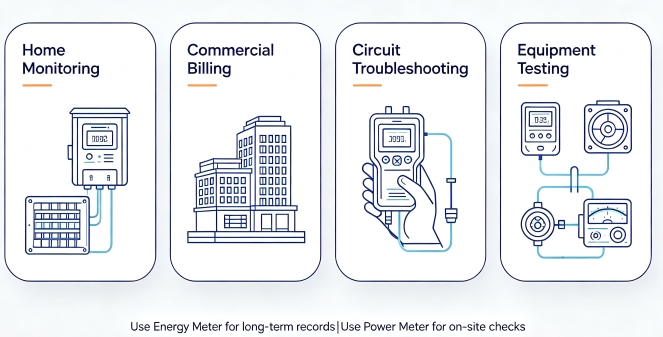
Home residential power monitoring
Single-phase energy meters are widely used in family electrical systems. They record total household electricity consumption and supply accurate readings for monthly billing. Home users can also track power usage trends to cut wasted energy. You can find reliable single-phase digital energy meter options (like T-DDS1946) for residential panel installation for your project.
Commercial building & factory power accounting
Office buildings, shops, and production workshops use 3-phase energy meters. These meters record heavy power loads for business electricity settlement. Facility managers use the data to track energy costs across different areas of the building.
Long-term energy saving analysis
Digital energy meters keep historical consumption data. Business owners and property teams review these records to find high-power equipment, adjust operation schedules, and lower overall electricity expenses.
Permanent electrical panel installation
For fixed electrical systems that run nonstop, energy meters mount onto panels for round-the-clock monitoring. They catch slow power loss issues that quick spot checks might miss.
4. When to Use a Power Meter
Power meters focus on real-time circuit testing and load checking. Choose this tool when you need instant power readings rather than long-term total consumption records.
Circuit troubleshooting & maintenance
Electricians use power meters to check live circuit load. They can spot sudden power spikes or abnormal load values and find hidden wiring faults quickly.
Equipment load testing
Before connecting new motors or electrical devices, technicians use power meters to test working load. This helps confirm whether the equipment matches the circuit capacity and prevents overload risks.
On-site temporary inspection
Many AC power meter models are portable. Contractors can carry them to different job sites to run quick spot checks without permanent panel installation.
Product power performance test
Manufacturers use power meters to test the power draw of finished electrical goods. This helps verify product performance and meet industry testing standards.
5. Common Mistakes When Choosing Energy Meter and Power Meter
Many buyers make simple but costly mistakes when picking between energy meters and power meters. Keep these common errors in mind to avoid bad purchases.
Assume one meter can fully replace the other
Some buyers believe a multi-function meter covers all needs. Even if a device displays both power and energy numbers, its core design still serves one main purpose. Relying on it for unsupported tasks will lead to unreliable readings.
Confuse search results with products
When searching for a power meter, results may show bike power meters and other non-electrical items. Skimming titles can lead you to add the wrong product to your order. Always double-check what the product measures.
Select based only on price
Cheap options may seem attractive, but they often lack stable reading accuracy. For billing or critical circuit testing, low-precision meters create big problems in data recording or fault detection.
Ignore your project goal
If you need monthly electricity billing records, a power meter cannot accumulate total usage. If you only need temporary circuit testing, a fixed energy meter is unnecessary overkill. Match the meter function to your task first.
6. Frequently Asked Questions
Q1: Can a power meter calculate my electricity bill?
A: No. A standard power meter only shows real-time power load. It cannot automatically add up total energy consumption over time to support billing. You will need an energy meter for this job.
Q2: Can I use an energy meter to catch sudden power spikes?
A: Energy meters track total cumulative usage. They are not designed to instantly capture short power spikes. Use a power meter if you need to monitor momentary load changes.
Q3: Are all power meters portable?
A: No. Power meters come in both fixed panel-mounted types and portable handheld units. Portable models are better for electricians who travel to different job sites.
Q4: What is an AC power meter used for?
A: An AC power meter measures real-time power values on alternating current circuits. Technicians use it to test load conditions and check equipment performance.
Q5: Is a digital energy meter more accurate than older models?
A: Yes. In most cases, digital energy meters deliver stable, precise cumulative readings for residential and commercial power recording.
Q6: Can one multi-function meter work for both billing and circuit troubleshooting?
A: It may show both data types, but you should verify its accuracy for your main task. Do not use it for official billing unless it meets local measurement standards.
Q7: Do I need a single-phase or 3-phase energy meter?
A: This depends on your power supply. Homes usually use single-phase energy meters, while factories and large commercial buildings typically require 3-phase energy meters.
Q8: How do I avoid mixing up electrical power meters with bike power meters?
A: Read product descriptions carefully. Check that the listing mentions circuit, AC, or electrical panel functions before you place an order.
Conclusion
When sourcing electrical measuring tools, the key is to separate energy meters and power meters based on your project goal. Energy meters record total power consumption over time for billing and long-term monitoring. Power meters capture instant load data for circuit checks and equipment testing.
Avoid common buying mistakes like mixing up product types or assuming one meter can handle all jobs. With this guide, you can pick the correct digital energy meter and prevent unnecessary project delays and extra costs. Knowing the difference between energy meters and power meters helps you make confident purchasing decisions for your electrical projects.