
Choosing the correct drill press size is the most critical step before purchasing a bench drill press. Many buyers prioritize price, speed gears, or appearance while ignoring core size parameters, which easily leads to limited processing range, unmatchable workpieces, and wasted machine performance. An improperly sized drill press can't adapt to your daily woodworking, DIY crafts, or metal-working tasks, leading to inaccurate holes, stuck drill bits, and low efficiency.
Drill press size is not defined by the machine’s external volume, but by practical working parameters including maximum drilling diameter, spindle travel, swing distance, and table capacity. Different size configurations suit different scenarios: home use, light workshop processing, and heavy-duty batch work. We will cover standard drill press size definitions, size comparison, scenario-based selection, maintenance tips, and common buying mistakes to help you pick the exact drill press size for your projects.
1. What Defines the Size of a Drill Press?
To pick the right drill press size for your jobs, you need to understand three core evaluation standards: machine type, key dimension specs, and motor power. These practical indicators show you the machine’s working range and capacity, instead of judging only by outward appearance.
Drill Press Machine Type
Drill presses fall into two main categories: benchtop models and floor-standing models. Floor-standing drill presses are heavy-duty industrial machines with large size, high power, and a wide swing range, built for long factory batch production. By contrast, benchtop drill presses feature compact frames, small footprints, and flexible operation. They are perfect for home DIY enthusiasts, hobbyists, and small workshop users. All our products are high-performance benchtop drill presses, ideal for entry-level daily use, precision woodworking, and light industrial drilling.
Swing and Spindle Travel
Swing is twice the distance between the spindle and support column. This measurement tells you the widest workpiece you can drill through its center. Spindle travel controls your maximum drilling depth. Our basic 13mm and 550W 16mm machines come with 50mm spindle travel, suitable for thin and mid-thickness boards. The laser-upgraded 16mm models bring up to 63mm or 80mm spindle travel. Our heavy-duty 25mm drill press delivers 85mm spindle travel, so you can drill deeper holes into thicker stock and larger pieces.
Motor Power Matching for Size Selection
Motor power supports the machine’s drilling capacity and stability. Motor wattage pairs directly with drill size and affects torque. Our entry-level 375W and 550W machines work great for everyday holes in wood and plastic. If you plan to drill metal alongside timber, choose the mid-range 750W or 1000W laser models for extra torque. Our 1200W heavy-duty 25mm bench drill is our most powerful unit. It handles deep drilling and large-diameter holes for workshop batch jobs.
Understanding these types, dimensions, and power standards stops you from buying blindly. You can easily match the correct bench drill press based on your workpiece width, drilling depth, material type, and project frequency.
2. Size & Spec Comparison for Our Models
To help you quickly tell the differences between sizes, below is an accurate size and specification table of our full bench drill press lineup. All data comes from real product parameters, with no inflated or fake marketing values.
| Model | Power | Chuck | Spindle Travel | Speed | Spindle-to-Column | Table |
| T-BDM-ZJ4113 (13mm) | 375W | 1.5–13mm | 50mm | 620–2620rpm, 5 levels | 105mm | 160×162mm |
| T-BDM-ZJQ4116a (16mm) | 550W | 3–16mm | 50mm | 620–2620rpm, 5 levels | 129mm | 196×198mm |
| T-BDM-5116 (16mm) | 750W (1hp) | 3–16mm | 63mm | 300–2550rpm, 12 levels | 129mm | 260mm |
| T-BDM-ZJ5116 (16mm) | 1000W | 3–16mm | 80mm | 300–2550rpm, 16 levels | 176mm | 290×290mm |
| T-BDM-ZJL5125 (25mm) | 1200W | 5–20mm | 85mm | 280–2380rpm, 12 levels | 176mm | 290×290mm |
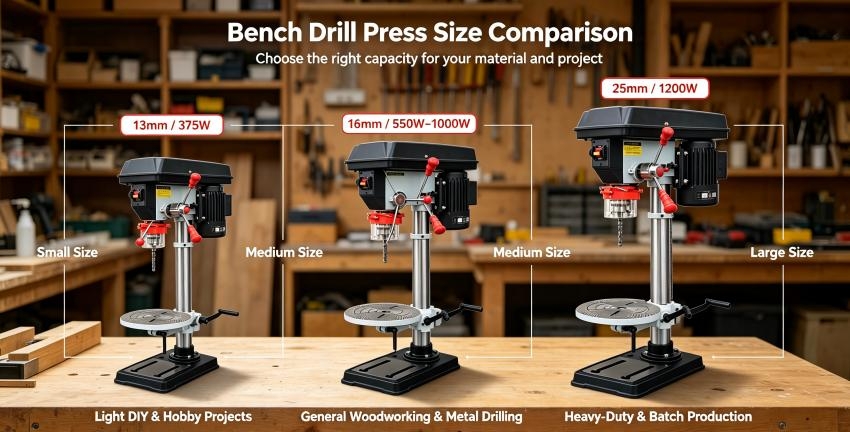
Small-size 13mm drill press: The 375W 5-speed model is the most compact option in our series. Designed for tiny hole drilling and thin workpieces, it fits household DIY and simple craft-making.
Standard medium-size 16mm drill press: Available in 550W, 750W, and 1000W variants. This is our most versatile and widely sold model. It balances working range, precision, and footprint for most woodworking and light metal drilling tasks.
Heavy large-size 25mm drill press: The 1200W upgraded model supports super-thick workpieces and large-diameter hole drilling. It works well for small workshop batch processing and heavy-duty projects.
3. How to Choose Drill Press Size for Different Jobs
Every woodworking, metalworking, or DIY project has unique workpiece dimensions, material density, and hole requirements. Picking the right drill press size is the foundation for safe, efficient machining. Choosing a drill press randomly causes two common problems: not enough working capacity to finish thick or large workpieces, or buying an oversized heavy machine that wastes power, budget, and workshop space.
Small-size 13mm Model for Home Beginner Use
If your daily work only includes household maintenance, thin wood crafts, plastic drilling, and small DIY projects, the compact 13mm drill press is your best match. It takes up little bench space, is simple to operate, and fully meets low-frequency, small-hole drilling needs without wasting power or performance.
The Medium-size 16mm Model for Daily Woodworking and Mixed Processing
For users who often process solid wood boards, furniture parts, thin aluminum sheets, and ordinary iron pieces, the 16mm size is the most flexible choice. You can pick the basic 5-speed ordinary version or the 12/16-speed laser precision version. The 16mm drilling capacity adapts to most daily processing sizes, with adjustable speed settings and high drilling accuracy.
The Large-size 25mm Model for Heavy-duty Workshop Processing
If you need to drill thick wood, thick metal plates or run long-term batch production, only the 25mm large-size drill press can handle the workload. Its bigger maximum drilling diameter and strong torque keep drilling stable for large holes, without bit shake, hole deviation or power shortage.
Besides selecting the machine size, you also need to pick matching vise accessories.
- 13mm small models support 2.5-inch and 3-inch flat vises or cross vises.
- 16mm and 25mm large-size models work with 4-inch vises.
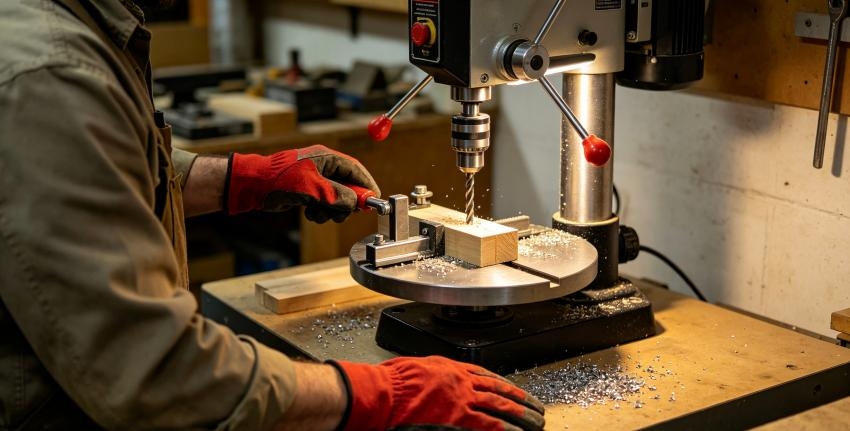
- 1000W and 1200W high-power models can install 302 precision rotary tables to complete multi-angle processing for large sheet metal.
4. Operation & Maintenance Tips
Correct operation and maintenance matched to your drill press size will extend machine life, keep consistent drilling precision, and avoid early component damage. Whether you own a small home bench drill or heavy-duty workshop unit, following these rules prevents expensive breakdowns and safety risks.
Avoid Overloading at All Times
Never drill holes larger than the machine’s rated maximum drilling diameter. Overloading the drill press puts extra force on the spindle. This causes spindle bending, fast chuck wear, and permanent precision loss. Once core parts get damaged, the drill press cannot process standard workpieces accurately, and repair costs will be high.
Carry Out Size-based Speed Adjustment Before You Drill
13mm and 16mm machines work best at high spindle speeds for thin, soft workpieces. High speed creates clean, smooth hole edges. For large, thick wood or dense metal workpieces, switch to low speed with high torque. Lower speed reduces drill bit heat buildup, stops bit breakage, and keeps your holes aligned on your marked lines.
Complete Regular Size Precision Calibration Periodically
Long-term continuous use creates minor vibration that shifts spindle alignment. Routinely check spindle verticality and chuck clamping accuracy. This check ensures your drill press keeps its standard processing capacity, holes stay straight, and dimensional errors do not ruin your workpieces.
Follow Targeted Cleaning and Storage Routines for Different Machine Sizes
Compact 13mm and 16mm models mainly need dust prevention. After use, clear wood chips and metal powder from the table, chuck and column. Dust particles wear moving parts over time. Large heavy-duty 25mm models need regular lubrication of high-load moving parts. Proper lubrication cuts friction, stabilizes performance during long heavy machining runs, and reduces unexpected downtime.
5. Common Mistakes When Picking a Drill Press Size
Most bad buying decisions for bench drill presses come from wrong size judgment. Many buyers mix up outer machine size with actual working specs, and end up with a drill press that cannot handle their projects. Learn these traps to choose the right drill press size for your workshop.
Confusing Appearance Size with Real Working Size
Many cheap drill presses look bulky on the outside, but their real maximum drilling capacity and swing are very limited. All our bench drill presses clearly mark the true drilling diameter and swing capacity on product specs. We do not use inflated or false parameters. You can directly compare rated size against your workpiece hole requirements.
Blindly Pursuing a Large-size Drill Press
A 25mm heavy-duty drill press is overkill for simple household DIY and hobby craft jobs. Oversized machines take up much more bench space, consume more power, and bring extra operational difficulty for beginners. New users may struggle to control its high torque, raising safety risks and wasting budget on performance they never use.
Ignoring Accessory Size Matching
Even if you pick the perfect drill press size, mismatched vise accessories ruin your drilling results. A vise that is too small cannot firmly hold large workpieces, while an oversized vise will not fit the drill table. Poor clamping lets workpieces shift while drilling, creating crooked holes, broken bits, and wasted material. Always match your vise and auxiliary accessories according to your drill press’s standard size.
6. FAQs About Drill Press Size Selection
Q: What size drill press do I need for home DIY?
A: For daily household repair and small craft projects, the 13mm small-size 375W model is sufficient. For slightly more woodworking tasks, the cost-effective 16mm 550W medium-size model is recommended.
Q: Is a larger drilling diameter always better?
A: No. A larger size means stronger processing capacity, but also larger volume and higher power. You should select the size according to your actual workpiece size to avoid performance waste.
Q: What size drill press is suitable for metal drilling?
A: Thin sheet metal works well with our 16mm bench drills. If you regularly drill thick metal plate, go for the heavy-duty 25mm 1200W model; its higher torque keeps holes steady.
Q: Do laser-equipped models have different size standards?
A: No. Laser positioning is a precision auxiliary function and does not change the machine’s original drilling diameter and swing size standards.
Q: Can I replace the chuck to get a larger drilling size?
A: No. The maximum drilling size is determined by the machine’s spindle power and structural design. Replacing the chuck cannot break the original size limit and will cause safety hazards.
Q: What size drill press do I need for drilling thick metal?
A: To drill thick metal, pick a drill press with a larger swing and a higher-power motor. Small bench drill presses are only fit for thin metal sheets.
Q: Does the vise choice affect what size drill press I should buy?
A: Yes. You need to check your vise size. A larger vise needs enough table space on your bench drill press. Match the vise to the drill press table dimensions before buying.
Quick Choose
Use this quick checklist to instantly match a suitable bench drill press based on your daily projects, workshop space, and material types.
Pick the 13mm bench drill press if:
You are a home DIY beginner, mainly doing household maintenance, thin wood crafts, plastic drilling, and occasional small hobby projects. You have limited bench space and only need low-frequency light drilling work.
Pick the 16mm bench drill press if:
You handle mixed daily woodworking and light metal tasks, including solid wood boards, furniture parts, thin aluminum, and ordinary iron. You want flexible adjustable speed options, and may upgrade to laser positioning for better drilling precision. This is the most versatile all-rounder for most hobbyists and small workshop users.
Pick the 25mm bench drill press if:
You need heavy-duty continuous processing, drilling thick hardwood and thick metal plates, or running batch production jobs. You require strong, consistent torque to avoid bit jitter and hole deviation for long hours of machining.
Quick Vise Accessory Tip:
13mm models: 2.5-inch / 3-inch flat vises or cross vises
16mm & 25mm models: 4-inch vises; 1000W /1200W units support optional 302 precision rotary tables for multi-angle sheet metal work