
A bench drill press is one of the most essential and versatile power tools for home DIY enthusiasts, woodworking hobbyists, and small workshop operators. Whether you are drilling small craft holes in softwood, creating precise furniture joints, or handling light metal fabrication tasks, a reliable bench drill press directly affects efficiency, hole accuracy, and overall project quality. However, choosing an unsuitable bench drill press often leads to common problems such as inaccurate hole positioning, unstable drilling speed, insufficient power for thick materials, or even unnecessary tool wear during long-term use. With a wide range of bench drill press models available on the market, choosing the right one for your specific needs can be confusing. This buying guide covers the key features, use cases, core specifications, and maintenance tips for common bench drill press models.
1. Main Types of Bench Drill Press
A bench drill press is a compact vertical drilling machine sharing a similar structure with pillar drills. It is also known as a table or pedestal drill. Besides drilling metal, it handles woodworking tasks, serving industrial, commercial, and home scenarios. It can perform operations including drilling, reaming, tapping, surfacing, and milling. Its stand supports height adjustment for simple setup. Thanks to its compact build, it can be placed on workbenches or floors without occupying much room.
Bench drill presses fall into two core categories: hand-feed and power-feed models.
Hand-Feed Drill Press
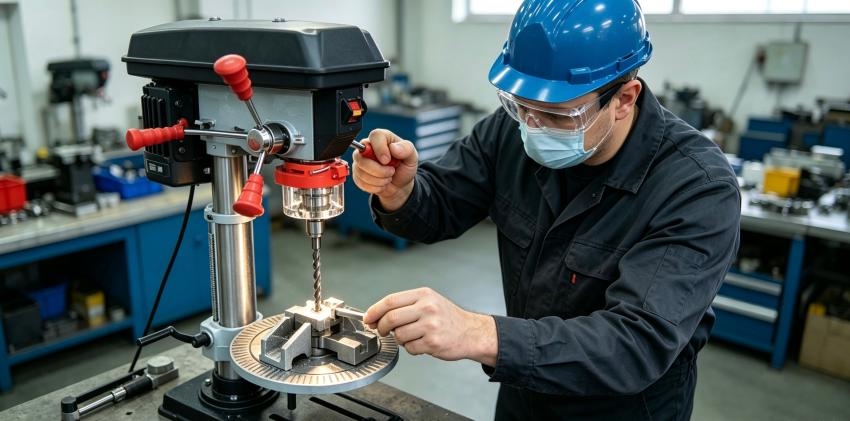
The hand-feed variant is the most widely used style. Lightweight and simply structured, it relies on manual feed handles. Operators can directly sense and control how the drill bit cuts into materials. Powered by a motor connected to the spindle pulley via a drive belt, it can be installed on tables or floors. This high-speed machine suits small workshops for holes no bigger than 1/2 inch. Users can release the lock bolts to slide the drill head up and down the column, adapting to different workpiece heights.
Power-Feed Drill Press
Power-feed drill presses are bulkier and heavier than hand-feed ones. They automatically advance the drill bit into materials at a pre-set cutting depth per spindle rotation. These machines fit maintenance workshops for medium and large-scale drilling work. Automatic feeding becomes necessary when hole diameters exceed 1/2 inch. Their spindle speed ranges roughly from 50 rpm to 1800 rpm, with a swing capacity of 17–22 inches and compatibility for drill bits up to 2 inches. T-bolts and clamps secure large workpieces, while a vise works for smaller items. A depth stop fitted near the spindle enables precise depth control.
Hand-Feed VS Power-Feed Models
Hand-feed and power-feed bench drill presses are suited for completely different drilling needs. Hand-feed versions are lightweight, manually controlled, and built for smaller holes (≤1/2 inch) and light-duty work. Power-feed bench drill presses are heavier, with automatic bit advancement. They handle holes over 1/2 inch, accept larger drill bits up to 2 inches, and deliver consistent precision for medium and heavy-duty workshop drilling.
2. How to Find the Best Bench Drill Press for Your Workshop Projects?
Selecting a suitable bench drill press starts with understanding your workshop projects. Different drilling jobs, workpiece materials, and usage frequencies demand distinct drill press specifications, including feed types, motor power, and speed ranges. Below we categorize the recommended bench drill press models for common workshop scenarios to help you pick the right unit for your needs.
For Hobby & DIY Woodworking
A hand-feed bench drill press is usually the best fit. Most home workshop projects involve drilling holes under 1/2 inch into timber, plywood, MDF, and soft non-ferrous metals. These small or mini bench drill presses are lightweight, affordable, and simple to set up on your workbench. With manual feed control, you get direct tactile feedback while using drill bits, so you can easily adjust pressure to avoid splitting wood or over-drilling. Adjustable drill head height lets you handle workpieces of varying thickness.
Looking for models with multiple speed settings, such as 5-speed bench drill press variants. Variable spindle speed protects delicate wood grain and reduces bit wear. A matching bench drill press vise is a helpful accessory to keep small wooden pieces secured and stable during drilling. This type of bench drill press is ideal if your projects are occasional: furniture making, craft work, cabinet repairs, and home improvement tasks. It does not require heavy workshop space and is straightforward to maintain for part-time use.
For Small Commercial Workshops
Small commercial workshops with medium-to-heavy drilling demands will benefit most from a power-feed bench drill press. When your work regularly requires holes larger than 1/2 inch, manual feeding becomes tiring and inconsistent, making automatic feed functionality a key advantage. Power-feed bench drill presses are heavier and more robust. They automatically advance drill bits at a preset rate for every spindle rotation, delivering repeatable, uniform hole depth across batch work. Their wide spindle speed range (roughly 50–1800 rpm) and large swing capacity (17–22 inches) support drill bits up to 2 inches, for metal, thick hardwood, and composite materials.
T-bolts, clamps, and a depth stop work together to secure large workpieces and guarantee precise depth control. This is critical for production, maintenance, and custom fabrication jobs where accuracy must stay consistent across dozens of parts. Although these models take up more space and come at a higher cost, they cut down operator fatigue and speed up batch drilling. If your workshop handles frequent, high-volume drilling tasks, the power-feed bench drill press is the reliable choice to boost your workflow.
3. Key Factors Before Buying a Bench Drill Press
To pick a suitable bench drill press for long-term use, you need to evaluate several core and practical specifications based on your daily processing needs.
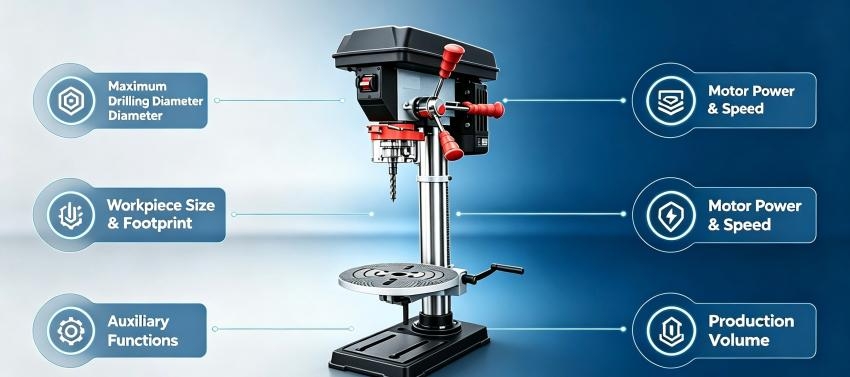
Maximum Drilling Diameter
Confirm the hole sizes you regularly drill. Our bench drill presses come in three standard sizes: 13mm, 16mm, and 25mm. The 13mm and 16mm models work well for general home DIY, wood crafts, and light metalwork. The upgraded 25mm version handles thicker materials and meets heavier drilling demands. Always match the maximum drilling diameter to your largest hole requirements.
Motor Power & Gear Speed
Motor power directly determines drilling performance. Our machine power covers 375W, 550W, 750W, 1000W and 1200W. Higher wattage delivers stronger torque for stable drilling on hard and dense materials. Variable speed control is a valuable bonus: slower speeds work for hard metals, while faster speeds deliver cleaner finishes on softer wood and plastic. Our products offer 5-speed, 12-speed, and 16-speed adjustable options to fit different workpieces.
Workpiece Size & Machine Footprint
Think about the size of your workpieces and the space you have in your workshop. Bench drill presses sit on your workbench, so check the machine footprint to make sure it fits your available area. Also check the swing capacity and table travel. These values decide how large a piece you can place under the spindle. Compact models suit small home workshops, while larger units are better if you often drill big boards or metal plates.
Auxiliary Functional Design
Check extra built-in features that improve your workflow. All 750W, 1000W, and 1200W models are equipped with laser positioning to improve drilling accuracy and avoid position deviation. Also, look at the supporting vise accessories. A flat vise, cross bench vise, and rotary vise are optional. These vises firmly fix workpieces and ensure stable and safe operation during processing.
Build Durability & Spare Parts
For long-term workshop use, solid build quality matters. A heavy cast iron table and frame reduce vibration during drilling and keep holes straight over time. Before purchase, confirm spare parts are easy to get. Worn chucks, belts, or depth stop parts need simple replacement. Hard-to-find parts will stop your work and create costly downtime.
Production Volume & Usage Frequency
Your daily usage decides which bench drill press fits best. If you only do occasional DIY or repair jobs, a lower-power model works well. If you run frequent drilling tasks or batch work, pick a higher-wattage heavy-duty model. It can withstand repeated use without overheating or losing precision.
4. Maintenance Tips & Safety Guidelines
Proper daily maintenance and standardized operation can effectively extend the service life of a bench drill press and maintain its long-term drilling accuracy. Regular inspection and simple upkeep are essential for both home and workshop equipment.
Keep The Machine Clean After Each Use
Wood chips, metal shavings, and dust easily accumulate on the worktable, spindle, and base. If left uncleaned for a long time, these residues may affect the flexibility of moving parts and cause slight drilling errors. Wiping the surface and clearing debris can maintain stable machine performance.
Maintain Regular Lubrication
Key moving parts, including the spindle, lifting column, and feed handle structure, need periodic oil lubrication. Proper lubrication reduces mechanical friction, prevents wear, and ensures smooth up-and-down adjustment and manual feeding during operation.
Follow Safe Operating Habits
Always fix workpieces with a matched vise before drilling, instead of holding materials by hand. This avoids workpiece shaking, drilling deviation, and potential safety hazards. Users should also check the bolt tightness and head stability before starting the machine to prevent vibration during high-speed rotation.
Store The Equipment Properly
Store the bench drill press in a dry, flat environment. Damp surroundings may cause metal rust on the spindle and accessories. Reasonable storage and daily inspection allow the bench drill press to maintain consistent precision for long-term repeated use.
5. Common Buying Mistakes To Avoid
Many buyers easily fall into misleading marketing traps when selecting a bench drill press, which may lead to low-precision drilling, insufficient power, or short service life. It is necessary to identify common pitfalls before purchasing.
Confusing Peak Power With Rated Power
Many low-quality merchants only mark peak power data to exaggerate machine performance. In actual use, peak power cannot last long and can easily cause motor overheating. All our models adopt standard rated power of 375W, 550W, 750W, 1000W, and 1200W, ensuring stable and continuous working output.
Ignoring The Actual Speed Adjustment Range
Some cheap drill presses claim multi-speed functions but only have a few effective gears. Our 5-speed, 12-speed, and 16-speed configurations provide truly adjustable speed ranges, which can freely switch between wood, plastic, and metal processing scenarios.
Overestimating Ordinary Models’ Drilling Capacity
Entry-level low-power machines cannot support drilling thick materials. Choosing a 13mm or 16mm model for heavy-duty work will cause tool jitter and inaccurate holes. For thick workpieces, you must select the 25mm high-power laser model.
Neglecting the Practical Value of Laser Positioning
Many buyers ignore positioning functions and purchase basic models blindly. Laser-equipped 750W, 1000W, and 1200W machines effectively reduce drilling deviation, which is essential for precise handmade and furniture production.
6. FAQs About Choosing a Bench Drill Press
Q: Which bench drill press is suitable for beginners?
A: The 375W 13mm 5-speed and 550W 16mm 5-speed models are the best choices for beginners. They are easy to operate, cost-effective, and fully meet daily DIY, woodworking, and simple household drilling needs.
Q: What are the advantages of laser positioning bench drill presses?
A: Laser positioning helps users quickly locate the drilling center, greatly reducing position deviation. It improves overall processing accuracy, especially for precise woodworking and light metal fabrication tasks.
Q: Do more speed gears mean better performance?
A: Not exactly. More speed options provide wider adaptability for different materials. 5-speed models are enough for simple daily work, while 12-speed and 16-speed versions are more suitable for mixed wood and metal processing with diverse requirements.
Q: What is the difference between 16mm and 25mm bench drill press?
A: The 25mm 1200W model has a larger drilling diameter and stronger motor torque. It supports thicker workpieces and long-hour heavy-duty work, while 16mm models are mainly used for medium and light daily processing.
Q: Are these bench drill presses compatible with different vises?
A: Yes, but vise sizes vary by model. The 13mm machine supports optional 2.5-inch and 3-inch flat or cross bench vises. 16mm and 25mm models are matched with 4-inch flat, cross, and precision bench vises. The 1000W and 1200W heavy-duty machines additionally support the 302-precision rotary table. You can pick accessories according to your machine model.
Q: What HP motor should I get for a bench drill press?
A: 1/3 HP works fine for casual DIY. 1/2 HP or higher is ideal if you plan frequent drilling on hardwood or thin metal sheets.
Q: Can I mount any bench drill press on my workbench?
A: Check the base size and weight first. You need a solid, flat workbench to fix the machine firmly to reduce vibration when drilling.
Conclusion
Selecting the right bench drill press does not require buying the most powerful or largest model. The best machine is always the one that fits your actual projects, workspace, and budget. Entry-level 5-speed models suit beginners and simple DIY tasks. Laser-equipped multi-speed versions are great for woodworking and light metalwork, while the 25mm heavy-duty model handles continuous workshop production. Remember to verify rated power, drilling capacity, and accessory compatibility before purchase. Avoid misleading marketing claims. Basic regular maintenance will preserve your machine’s precision and extend its service life. Choose wisely based on your real drilling tasks.