
For electronics assembly, appliance manufacturing, automotive production, and general-purpose assembly workshops, choosing the best automatic screw feeder can have a huge impact on daily production throughput, line efficiency, and overall assembly quality. A high-quality automatic screw feeding machine reduces repetitive manual screw-picking labor, minimizes screw jams and missed fasteners, lowers operator fatigue, and helps manual assembly stations or robotic screwdriving systems operate consistently, reliably, and with less downtime. From handheld electric screwdrivers to robotic screwdriving automation, a reliable screw feeder or automatic screw presenter keeps fasteners staged, oriented, and ready for driving. Whether you are equipping a single benchtop workstation or integrating a screw feeding system into a fully automated assembly line, the right automatic screw feeder can improve productivity, support stable torque delivery, and reduce long-term assembly costs.
Many workshop managers and equipment buyers only check screw thread size when shopping for an automatic screw feeding machine. In real-world production, however, feeding performance depends on many other critical details: screw overall length, screw head style, feeding mechanism type, hopper storage capacity, built-in screw counting feature, discharge speed, and compatibility with your existing electric screwdrivers or automation hardware. Overlooking these factors can lead to frequent screw jams, missed fasteners, damaged screw heads, inconsistent feeding, or a screw feeder that cannot keep up with your takt time. That is why a proper automatic screw feeder buying guide should evaluate the complete screwdriving workflow, not just the screw size.
This practical automatic screw feeder buying guide breaks down all core selection criteria, and helps you select the right model. The goal is to help you avoid over-spending, reduce the risk of buying poorly matched equipment, and choose a screw feeder system that improves throughput, minimizes downtime, and supports consistent, reliable screwdriving in both manual assembly stations and robotic screwdriving systems.
What Is an Automatic Screw Feeder?
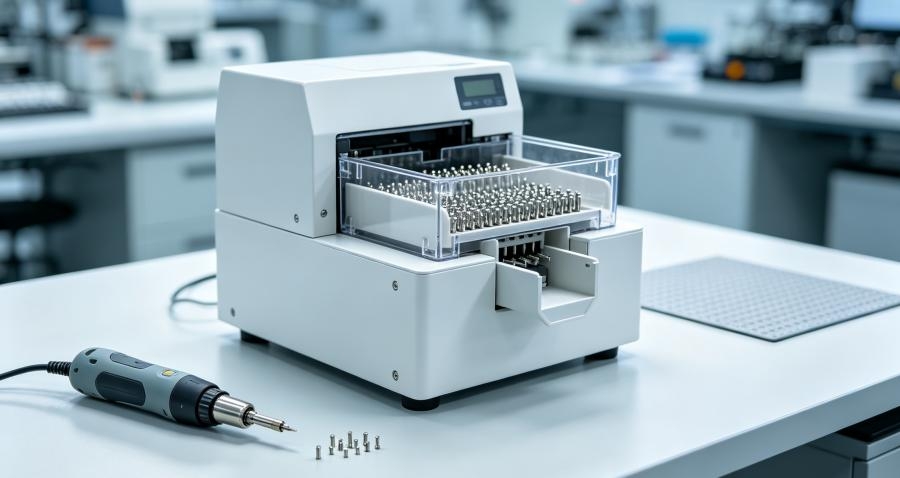
An automatic screw feeder is standalone bench-top equipment that sorts, orients, and delivers one single screw at a time to your screwdriver bit. It eliminates the slow, error-prone step of operators picking individual screws from plastic trays or bulk containers.
These compact table-top units are different from large vibratory bowl feeder systems. Bench-top screw feeders are built for standardized small-to-medium screws, designed for quick setup, simple change-over, and direct pairing with handheld electric screwdrivers or small robotic fastening modules. Most commercial models include built-in hoppers, orientation structures, digital counters, and brushless drive systems for low-noise, long-hour workshop operation.
Common use-cases: manual assembly stations, semi-automated work cells, low-to-medium batch production, small-volume contract manufacturing.
Automatic Screw Feeder Types: Key Differences & Uses
When shopping for reliable fastener feeding equipment for automated assembly lines, it’s critical to understand the core mechanical differences between mainstream feeder designs. The internal feeding mechanism defines every machine’s compatibility, feeding stability, jam resistance, and overall performance with varying screw sizes, lengths, and surface conditions. On today’s industrial market, digging-type and turntable-type (adsorption) feeders stand out as the two most common and practical bench-top solutions deployed across electronics, automotive, and home appliance assembly workshops. While both styles are engineered to automate screw sorting, orientation, and single fastener delivery, their structural principles and operational characteristics vary significantly, making each model better suited for distinct production scenarios and fastener types.
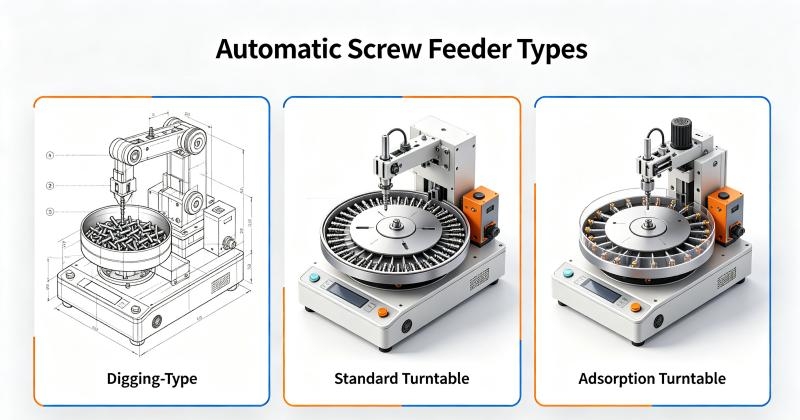
| Feeder Mechanism | Core Working Principle | Best-Fit Screw Range | Key Strengths | Main Limitations |
| Digging-Type Screw Feeder | Rotating digging arm lifts screws and separates one fastener into the output slot | M1.4-M5.0, screw length ≤20 mm | Cost-effective, simple internal structure, easy routine cleaning | Not ideal for ultra-tiny screws below M1.4; long screws risk tangling |
| Standard Turntable-Type Feeder | Rotating disc carries screws; mechanical positioning separates single screw for discharge | M0.8-M2.0, screw length ≤8 mm | Excellent performance for micro-small screws, compact footprint | Limited maximum screw length, smaller hopper volume |
| Adsorption Turntable-Type Feeder | Brushless-driven turntable + mechanical locating structure, stable single-screw separation | M0.8-M6.0, max length up to 30 mm | Wide screw compatibility, stable running, optional large-capacity hopper | Higher price point than digging-type models |
7 Key Factors for Choosing an Automatic Screw Feeder
1. Full Screw Dimensions (Not Only Thread Size)
- Thread diameter is just one piece of data. Always collect this complete set of fastener information:
- Thread size (M0.8 / M1.4 / M3 / M6 etc.)
- Overall screw total length
- Screw-head type: pan-head, flat-head, washer-head
- Special notes: self-tapping threads, oily surface coating, cosmetic-grade scratch-sensitive screws
Even two screws sharing identical thread size can behave differently. A short M2 pan-head screw will feed without trouble, but a long M2 self-tapping screw may cause jamming or overlapping if the feeder’s maximum supported length is too short.
- Digging-type units: digging screw feeder with M1.4-M5.0 for screw lengths up to 20 mm
- Small turntable: dedicated micro-screws M0.8-M2.0 for short screws ≤8 mm
- Adsorption turntable series: flexible options from M0.8-M5.0 up to heavy-duty M2.0-M6.0 (max screw length 30 mm)
2. Required Feeding Speed
Real-world output differs from theoretical peak values.
- Digging-type models typically deliver 60-180 screws per minute under good working conditions
- Turntable-based feeders deliver consistent single-screw output for steady-pace assembly
Keep your actual station cycle time in mind. If your whole workstation only finishes 30-40 fastening cycles per minute, you do not need to chase the absolute maximum feeding speed. Excess speed brings no real benefit and may raise unnecessary equipment cost.
3. Hopper Storage Volume & Screw Loading Capacity
Hopper capacity directly defines how long your station can run between manual refills.
- Small 80 cc hoppers: fit tiny M0.8-M2.0 micro-screws; expect frequent refills for high-speed stations
- Medium-size 200-220 cc: balanced choice for most M1.4-M5.0 general-purpose fasteners
- Large-volume 600 cc bin (M2.0-M6.0 turntable automatic screw feeder): great for large-size screws, drastically cuts frequent top-ups during multi-shift operation
Also check the maximum number of stored screws listed for each model: storage count changes significantly between tiny micro-screws and larger M3.5-M6 fasteners even with identical hopper volume.
4. Digital Counting Function
Most modern automatic screw feeders include a digital display and screw counting feature. This practical function helps production teams:
- Track total completed fastening quantity for each work order
- Detect abnormal feeding conditions such as continuous no-screw output
- Simplify daily production statistics
For manual assembly stations, counting is a highly recommended feature.
5. Compatibility With Your Existing Equipment
Bench-top screw feeders work with handheld electric screwdrivers by default. If you plan to connect it to a small robot or automated fastening mechanism:
- Confirm the feeder’s output-port physical dimension
- .Check signal trigger interface availability
- Verify whether your robot’s picking stroke matches the screw-delivery position
6. Change-Over Frequency Between Different Screw Types
If your workshop switches frequently between multiple screw specifications:
- Bench-top feeders are best for one dedicated screw size per machine
- Frequent swapping of different screw types requires thorough internal cleaning to avoid leftover mixed fasteners
- For production lines rotating through dozens of different screws, you may also need to consider modular vibratory bowl feeding solutions as an alternative
7. Working Environment & Maintenance Needs
Standard bench-top screw feeders are designed for normal indoor assembly workshops. Avoid placing them in heavily dusty, wet, or oily environments without proper protection.
Daily maintenance work is simple:
- Regularly empty and clean the hopper to remove fine metal debris
- Keep feeding channels free of accumulated dust and screw chips
- Follow manufacturer guidance for routine inspection of moving internal parts
Most Common Buying Mistakes to Avoid
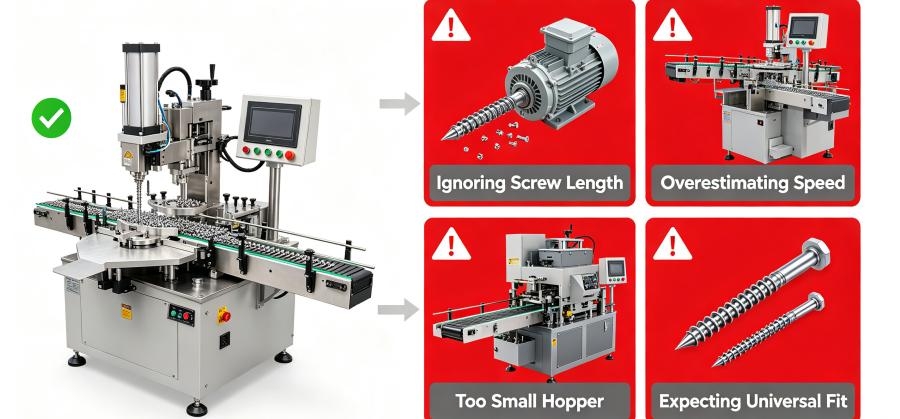
- Buy only according to thread size, ignoring total screw length Many jamming and mis-orientation issues happen because buyers overlook maximum supported screw length. A feeder supporting M5 screws may NOT handle a 30 mm-long M5 screw.
- Over-estimating real feeding speed Published peak PPM numbers are tested under ideal lab conditions with perfectly clean, standard screws. Oily screws or slightly deformed fasteners will lower real-world output.
- Ignoring hopper size and refill frequency A cheap small-capacity feeder can become a bottleneck if operators have to refill screws every 10-15 minutes during continuous shifts.
- Expecting one machine for many different screw variants Bench-top automatic screw feeders are optimized for a narrow screw specification band. Frequent mixing of vastly different screw sizes leads to poor stability
Quick Selection Checklist for Buyer
Tick these points before finalizing your purchase:
- Record full screw data: thread size, total length, head shape, surface condition (oily / cosmetic requirement)
- Confirm your average station cycle / required feeding rate
- Estimate acceptable interval between screw refills to decide hopper capacity
- Confirm hardware matching: handheld screwdriver or robotic integration
- Verify whether digital counting function is required for your production management
- Check the official model’s hard limits: maximum screw length, compatible head-thickness requirements
FAQ: Automatic Screw Feeders
Q1: What’s the difference between an automatic screw feeder and a screw conveyor?
A: A screw feeder meters screws one at a time from a hopper to a driver. A screw conveyor moves bulk material over distance. They solve completely different problems.
Q2: Can one machine feed multiple screw sizes?
A: Most bench-top feeders are optimized for one screw specification at a time. If you switch sizes often, use multiple dedicated feeders or a modular vibratory bowl system. Mixing screws in one hopper usually leads to trouble.
Q3: Can I connect a screw feeder to a robot?
A: Yes. But confirm the output port dimensions, pick-up height, trigger signal, and robot stroke. The robot’s gripper or vacuum nozzle must match the screw delivery position exactly.
Q4: Is a faster feeder always better?
A: No. Match the feeder to your takt time. If your station only completes 30–40 fastening cycles per minute, buying a feeder that claims 180 PPM may add cost without adding real value.
Q5: How do I prevent mixed screws?
A: Use one feeder per screw type when possible. If you must change screws, empty the hopper completely, blow out the track, and inspect all corners. A quick-change hopper design helps.
Q6: How often should I maintain an automatic screw feeder?
A: Daily: clean the hopper. Weekly: clean the track and sensors. Monthly: inspect brushes, separator plates, and grounding. Follow the manufacturer’s manual for lubrication and wear parts.
Q7: What should I do if the feeder keeps jamming?
A: First, check the screw itself: length, head shape, coating, and oil. Then check the track, brush pressure, separator, and speed. If the screws are outside the feeder’s supported range, no adjustment will fix it reliably.
Q8: How do I know if I chose the right feeder?
A: You’ll know when it runs for a full shift with low jam rates, accurate counting, fast changeover, stable driver or robot pick-up, and simple maintenance. If operators are constantly clearing jams or refilling the hopper, the feeder is not the right fit.