
For electronics, appliance, automotive and general assembly workshops, choosing the correct automatic screw feeder directly impacts your production uptime and reduces unexpected downtime from screw jams. Two widely-used bench-top models are turntable automatic screw feeders and digging-type automatic screw feeders. Many production managers wonder what is the difference between turntable and digging screw feeders and often purchase poorly matched equipment that causes frequent jamming or fails to fit their screw specifications.
Although both units sort, orient and feed single screws to your screwdriver, they operate with completely different internal mechanisms. Each design performs best for specific screw sizes, production batch sizes and workshop conditions. This practical guide explains their operation, compares advantages and drawbacks, and helps you select the suitable feeder for your assembly application. Our product portfolio offers both turntable and digging automatic screw feeders to satisfy various fastener feeding demands on production lines.
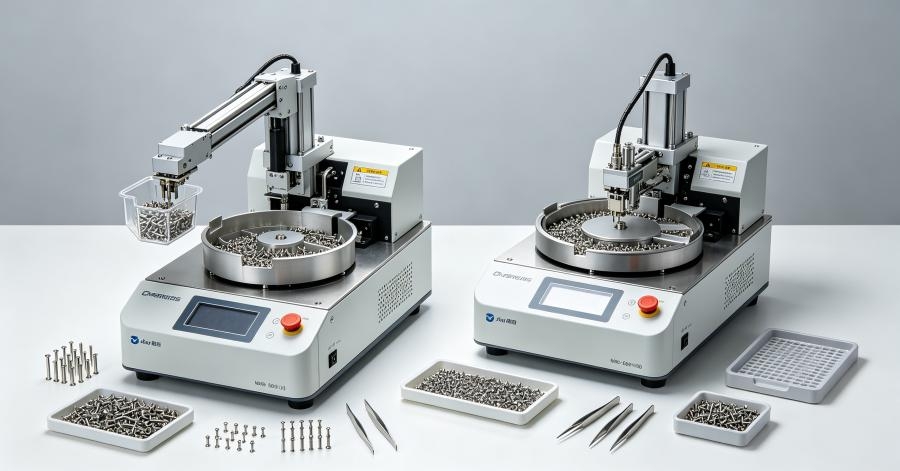
How Does a Digging Automatic Screw Feeder Work?
A digging automatic screw feeder uses a rotating digging arm inside the hopper. The arm gently stirs and lifts bulk screws up to the sorting track. Screws fall into position one by one, oriented correctly before reaching the outlet ready for pickup by your handheld screwdriver.
This mechanical structure is simple and easy to access for cleaning and routine maintenance. It works best for mid-range standard screws and is widely adopted in low-to-medium volume manual assembly stations.
Best Applications for Digging Automatic Screw Feeders
- General electronics assembly
- Household appliance manual workstations
- Small to medium standard screws with stable batch quality
- Factories looking for budget-friendly screw feeding equipment
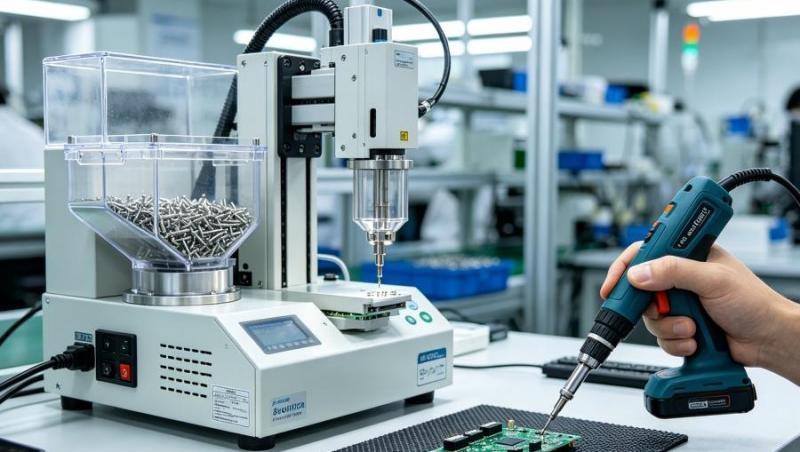
How Does a Turntable Automatic Screw Feeder Work?
The turntable automatic screw feeder uses a rotating disc with precision positioning slots. As the disc spins, screws drop into individual slots and get aligned mechanically. Adsorption turntable models add vacuum assistance for extra stability, especially for tiny micro screws.
Since each screw sits in its dedicated slot, this design offers superior separation accuracy. It reduces overlapping screws and mis-orientation, which is critical for ultra-small fasteners that tangle easily.
Best Applications for Turntable Automatic Screw Feeders
- Precision electronics assembly with micro screws
- Automated robotic screwdriving cells
- Products with strict cosmetic requirements (scratch-sensitive screws)
- High-precision small component assembly
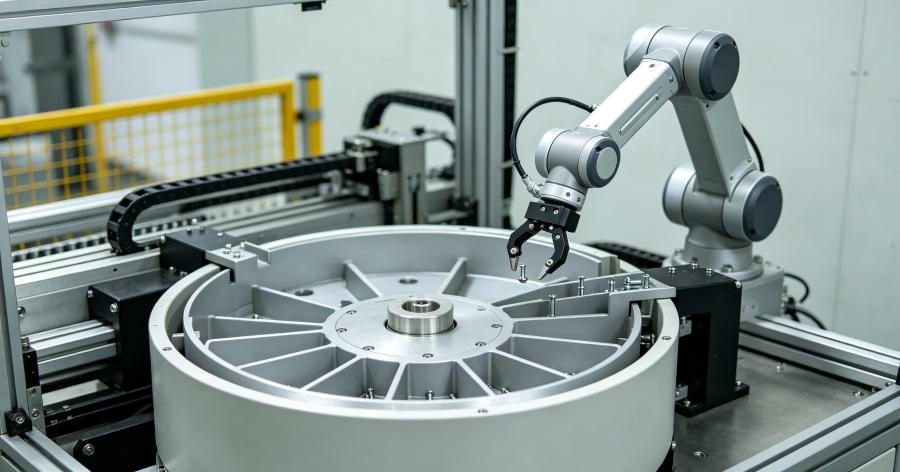
Turntable vs Digging Automatic Screw Feeder
| Comparison Item | Digging Automatic Screw Feeder | Turntable Automatic Screw Feeder |
| Working Mechanism | Rotating digging arm lifts and separates screws | Rotating disc with positioning slots; adsorption models use vacuum assistance |
| Compatible Screw Range | M1.4–M5.0, max screw length 20 mm | Standard turntable: M0.8–M2.0, length ≤8 mmAdsorption turntable: M0.8–M6.0, max length 30 mm |
| Feeding Stability | Good for standard screws; higher jam risk for micro or long thin screws | Excellent for micro screws; low rate of mis-orientation |
| Cost Level | Lower upfront cost | Standard turntable: medium cost; adsorption turntable: higher cost |
| Maintenance | Simple structure, easy to clean and inspect moving parts | Requires careful cleaning of turntable slots; adsorption models need periodic vacuum check |
| Ideal Production Speed | 60–180 screws per minute for standard fasteners | Consistent steady output, great for robotic fixed-cycle assembly |
| Limitations | Tiny screws easily slip; long screws may get tangled | Smaller hopper for basic micro turntable versions; more parts to inspect |
Note: Always test your actual screw samples before final purchase.
Key Factors to Choose Between Turntable and Digging Screw Feeder
1. Screw Size, Head Type and Surface Condition
Screw specification is your first filter. Start with thread size, overall length, head style, and surface condition—not just thread diameter. If you’re running micro screws below M1.4, or small cosmetic-grade screws that scratch easily, a turntable feeder is usually the safer choice. In this category, an adsorption turntable model is often recommended because it handles tiny screws more gently and consistently.
Standard turntable feeders are commonly used for M0.8–M2.0 micro screws up to about 8 mm long. Adsorption turntable models can handle a wider range, roughly M0.8–M6.0 with lengths up to 30 mm. For standard screws from M1.4 to M5.0 with lengths under 20 mm, a digging feeder often delivers reliable performance at a lower cost.
But screw size alone doesn’t tell the whole story. Oily, coated, damaged, or deformed screws can cause feeding problems in either type. Self-tapping screws may tangle if they exceed the feeder’s supported length. Always test with the exact production screws before you buy.
2. Manual Workstation or Robotic Screwdriving
Digging feeders are a natural fit for manual assembly stations with handheld electric screwdrivers. They’re simple, cost-effective, and easy to maintain. Turntable feeders—especially adsorption turntable models—typically present each screw in a more stable, repeatable position at the outlet. That makes them generally easier to integrate with robotic pick-and-place or automated screwdriving systems.
But “robot-ready” doesn’t mean plug-and-play. You still need to confirm the output port dimensions, pick-up height and angle, trigger signal type, and whether your robot’s picking stroke matches the screw delivery position. If those details don’t line up, even a high-quality feeder can underperform.
3. Budget and Long-Term Maintenance
On upfront cost, digging feeders usually have the advantage. They contain fewer precision components, their spare parts tend to cost less, and daily cleaning is often quicker and simpler. That makes them a practical choice when you need to equip multiple manual stations while keeping capital spending under control.
Turntable feeders, especially vacuum adsorption models, require a higher initial investment. However, for micro-screw or high-precision assembly, they can reduce downtime caused by jams and mis-feeds—saving labor, scrap, and frustration over time. The smart way to compare is total cost of ownership: purchase price, wear parts, cleaning time, maintenance, and production downtime. A cheaper feeder that jams every shift isn’t really cheaper.
4. Production Batch Change Frequency
If your line frequently switches between many different screw sizes, neither a bench-top digging feeder nor a bench-top turntable feeder is ideal. Each bench-top feeder is calibrated for a narrow screw range. Moving from one screw type to another usually requires a full clean-out to avoid mixed screws, and that adds changeover time.
For occasional changes, multiple dedicated feeders or quick-change hoppers can help. For frequent, high-mix production with many screw variants, a vibratory bowl feeder system may be a better fit—but it comes with higher cost, a larger footprint, and more setup complexity. Match the feeding solution to your changeover frequency, not just the screw size.
Turntable or Digging Screw Feeder?
There’s no universal “better” option. The right automatic screw feeder depends entirely on your fasteners, your assembly workflow, and how you measure value over time. A feeder that works perfectly at one workstation can be a headache at another. Use the guidelines below as a starting point—then confirm the hard limits with your supplier and test with your actual production screws.
Digging feeders are often the practical choice for standard screws
Digging feeders use a rotating digging arm to lift and separate screws. They’re mechanically simple, which is a big advantage in real production. Fewer precision parts usually means lower upfront cost, cheaper spare parts, and faster daily cleaning. For manual stations using handheld electric screwdrivers, a digging feeder is often all you need—especially for M1.4–M5.0 screws under 20 mm.
That said, they can struggle with very tiny screws, long screws, or screws that tend to tangle. If your screws are below M1.4, very lightweight, or easily scratched, a digging feeder may not be the best match.
Turntable feeders are often the better fit for micro screws and robotics
Turntable feeders use a rotating disc and a mechanical positioning structure to separate one screw at a time.Standard turntable models are built for precision micro screws, covering the common M0.8–M2.0 size range with a maximum length of 8 mm. To accommodate diverse production needs and different fastener specifications, including M0.8–M5, M1.7–M5.0, and M2–M6 models, providing a wide selection to match various screw sizes and assembly applications.
That stable positioning is why turntable feeders, especially adsorption types, are often easier to integrate with robotic pick-and-place screwdriving systems. But “easier” is not the same as “automatic.” You still need to confirm:
- Output port dimensions and screw pick-up position
- Pick-up height, angle, and robot stroke
- Trigger signal type: IO, RS232, pneumatic, or another interface
- Driver bit, vacuum nozzle, or gripper compatibility
- Required takt time and refill interval
Common Buying Mistakes When Selecting Automatic Screw Feeders
- Choosing a digging feeder for micro screws. Tiny fasteners often slip away from the digging arm and cause frequent feeding failures.
- Buying a basic small turntable feeder for long screws. The disc slot design cannot support screws longer than its rated limit.
- Ignoring screw surface coating. Polished or oily screws increase slip risk on both types, even if the thread size matches.
- Overlooking integration needs. If you plan to connect to robots, confirm signal interfaces and outlet position before ordering.
Quick Buyer Checklist
- Record full screw specs: thread size, total length, head shape, surface coating
- Confirm whether the station uses manual screwdrivers or robotic fastening
- Estimate required feeding speed and daily production volume
- Check maintenance manpower available on your workshop floor
- Test screw samples with our technical team before purchase
Q&A: Common Problems with Machine Selection
Q1: Is a turntable screw feeder always better than a digging screw feeder?
A: No. There’s no universal “better” type. A turntable feeder is often better for micro screws, scratch-sensitive fasteners, and robotic screwdriving. A digging feeder is often a better fit for standard M1.4–M5.0 screws under 20 mm, manual assembly stations, and budget-conscious projects. The right choice depends on your screws, workstation, and production volume.
Q2: Which type should I choose for micro screws below M1.4?
A: In most cases, choose a turntable feeder. A standard turntable screw feeder with M0.8–M2.0 micro screws up to about 8 mm long is commonly. Digging feeders are generally not ideal for ultra-tiny screws below M1.4.
Q3: Which type is cheaper to maintain over time?
A: It depends on your application. Digging feeders are often simpler to clean and maintain day to day. But turntable feeders can reduce downtime caused by jams and mis-feeds in micro-screw or high-precision assembly. The smarter comparison is total cost of ownership: purchase price, wear parts, cleaning time, maintenance, and production downtime.
Q4: Can either type handle oily, coated, or deformed screws?
A: Both types can struggle with heavily oily, coated, damaged, or deformed screws. Contaminated fasteners may stick, slip, or feed at an angle. If your screws have oil or coating, test them with the feeder before buying. In some cases, cleaning the screws or choosing a different feeding method may be necessary.
Q5: Can I use one bench-top feeder for many different screw sizes?
A: Not really. Most bench-top feeders—whether digging or turntable—are calibrated for a narrow screw range. If you frequently switch between many screw sizes, you’ll need to fully clean the feeder between batches to avoid mixed screws. For high-mix production, consider multiple dedicated feeders, quick-change hoppers, or a vibratory bowl system.
Q6: How do I know which feeder is right for my production line?
A: Start with your screw data: thread size, overall length, head type, and surface condition. Then confirm whether the station is manual or robotic, how often you change screws, and what takt time you need. Finally, test the feeder with your actual production screws and check the supplier’s hard limits. Don’t choose based on price or PPM alone.