
When it comes to preparing metal edges, two tools are commonly used: a dedicated chamfering machine and an angle grinder. Both can remove sharp edges, create bevels, and prepare metal for welding, but they are designed for very different workflows. So, which is better—a chamfering machine or an angle grinder? The answer depends on how often you chamfer metal, how consistent the results need to be, and how much material you need to process. An angle grinder is a versatile and affordable choice for occasional jobs and general workshop tasks. A dedicated chamfering machine, on the other hand, is built for faster, more consistent, and repeatable edge preparation.
In this guide, Tool.com store compare a chamfering machine vs. an angle grinder in terms of precision, speed, finish quality, versatility, safety, and cost. By the end, you'll have a clearer idea of which tool is the right choice for your workshop or metalworking application.
- What Is a Chamfering Machine?
- What Is an Angle Grinder?
- Chamfering Machine vs. Angle Grinder: Key Differences
- Chamfering Machine vs. Angle Grinder: Which One Should You Choose?
- Frequently Asked Questions
- Conclusion
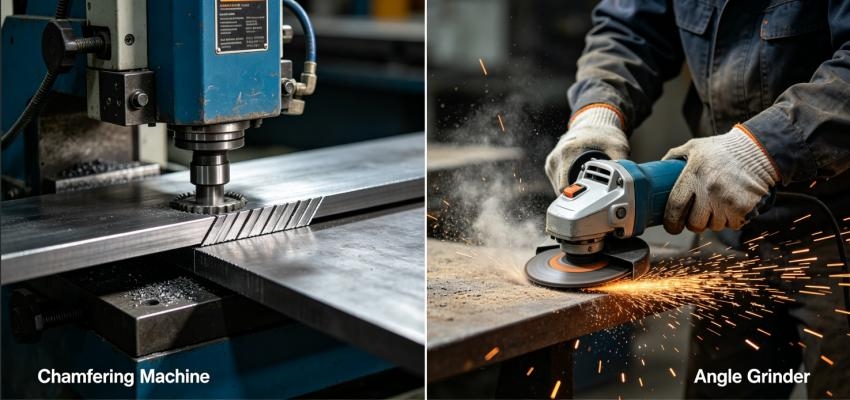
What Is a Chamfering Machine?
From day‑to‑day operations in fabrication shops across North America and Europe, many tradesmen still rely on angle grinders for everyday edge cleanup, even when consistency really counts. A chamfering machine is purpose‑built metal‑finishing gear focused entirely on creating clean, repeatable bevels while stripping sharp burrs off workpieces. Unlike multi‑purpose power tools that juggle dozens of jobs, this specialized metal edge‑finishing equipment is built to deliver precise edge finishing for welding prep, component assembly and final‑part quality control.
If consistent bevel geometry, low scrap rates and reliable burr removal are high priorities for your workshop projects, dedicated industrial chamfering equipment helps you hit those standards day‑in and day‑out.
How Does a Chamfering Machine Work?
To put it simply: instead of forcing operators to hold a tool steady by hand, a chamfering machine uses mechanical positioning to lock in your target chamfer angle and cutting depth. Most models use high‑speed rotating milling cutters to machine the workpiece edge, rather than just grinding material away. Operators dial in their desired settings up front. Once configured, every piece that runs through gets the exact same bevel, with no guesswork required.
Portable handheld variants are built for on‑site work, while bench‑mounted and semi‑automatic styles keep up with higher‑volume shop production. This mechanical setup is what separates it from manual grinding, where even tiny hand shake can alter finished edge quality.
Common Applications of Chamfering Machines
A chamfering machine comes into play whenever quality and repeatability cannot be compromised. Its most frequent job is welding preparation for structural steel and pipe‑fitting projects, where consistent bevels directly improve weld strength and cut down on costly defects. It also shines for mold making, automotive component finishing, batch‑run hardware parts, and general metal part deburring. Whether pre‑processing parts for assembly, removing sharp hazardous edges, or cleaning up cut marks left by plasma or saw cutting, this tool removes much of the guesswork from edge finishing. Hobbyists with high standards and full‑time commercial fabricators alike benefit from adding this equipment to their workshop workflow.
Key Advantages of a Chamfering Machine
- Consistent batch‑processing results: Delivers identical chamfer dimensions across multiple workpieces, eliminating uneven edges caused by manual hand‑grinding.
- Low operator‑skill dependency: Thanks to fixed mechanical positioning, even less‑experienced operators can produce qualified chamfers without extensive training.
- Superior performance on soft metals: Controlled milling action minimizes gouging, scratching and surface tearing when processing aluminum and other soft alloy materials.
- Improved workplace safety: Generates fewer sparks and greatly reduces kick‑back hazards compared with handheld grinders, making long‑duration operation safer.
Lower overall production cost: Cuts rework time and reduces rejected workpieces, bringing tangible cost savings for commercial‑volume fabrication tasks.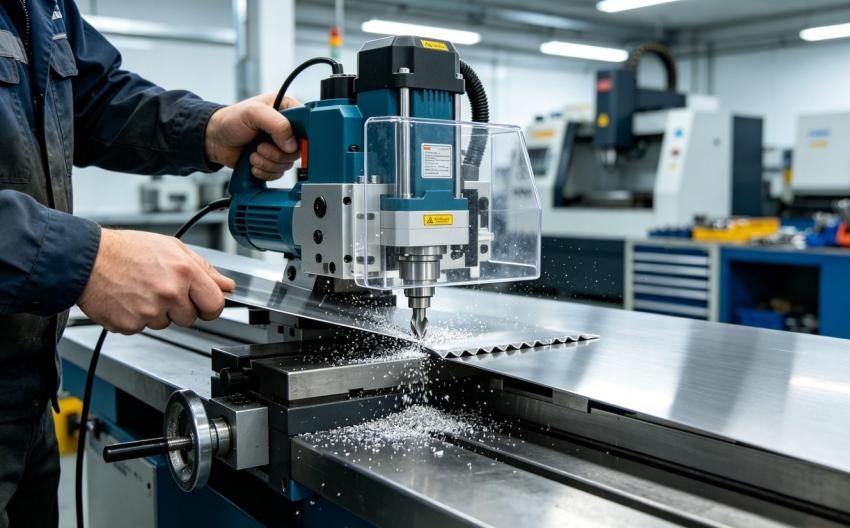
What Is an Angle Grinder?
Walk into nearly any fabrication shop, garage or job‑site across North America and Europe, and you will spot an angle grinder within easy reach. As someone who works with metal tools day‑in and day‑out, I consider this compact power tool one of the most universal pieces of kit you can own. An angle grinder is a high‑speed handheld power tool built for cutting, grinding and surface conditioning across multiple materials. This versatile handheld abrasive tool earns its place in countless workshops thanks to its wide‑ranging functionality and flexible on‑site usability.
If you only need occasional edge work, mobile repairs or quick touch-ups on metal parts, a handy angle grinder gives you the flexibility to get the job done.
What Can You Do With an Angle Grinder?
I rely on my angle grinder for a huge variety of daily shop tasks. Fitted with different discs and wheels, it handles metal cutting, rust removal, weld slag cleaning, surface grinding and rough polishing. Beyond metal work, it also makes short work of stone, tile and concrete material on repair or renovation jobs. Its lightweight handheld build means you can carry it out to remote job‑sites without needing a fixed workbench or heavy‑duty power setup. For general‑purpose metal modification, few tools offer this level of adaptability.
Why Use an Angle Grinder for Chamfering?
It is easy to understand why so many tradesmen reach for an angle grinder when they need to create a chamfer or bevel. First off, most workshops already own one, so there is no extra equipment purchase required for occasional edge‑finishing work. Setup takes only moments; swap over to a suitable grinding disc and you can start working immediately. For random, one‑off parts or emergency on‑site adjustments, it delivers fast results without bringing in specialized machinery. When chamfering is only a small, secondary part of your overall job, this tool feels like the most practical, time‑saving choice.
Key Advantages of Using an Angle Grinder for Chamfering
- Excellent portability for field jobs: Fully handheld and lightweight, it works perfectly for on‑site repairs where large stationary machines cannot be moved.
- No extra capital investment: Most shops and DIY users already own an angle grinder, so no additional tool purchase is needed for infrequent chamfer work.
- Fast, minimal‑effort setup: Simply swap out the grinding disc, and operators can begin chamfering right away with no complex parameter configuration.
- High task flexibility: Beyond chamfering, the same tool handles cutting, rust removal and weld cleaning, supporting mixed‑task workflows.
Great for one‑off or low‑volume work: Delivers quick results for emergency adjustments and non‑critical single‑piece projects without lengthy preparation.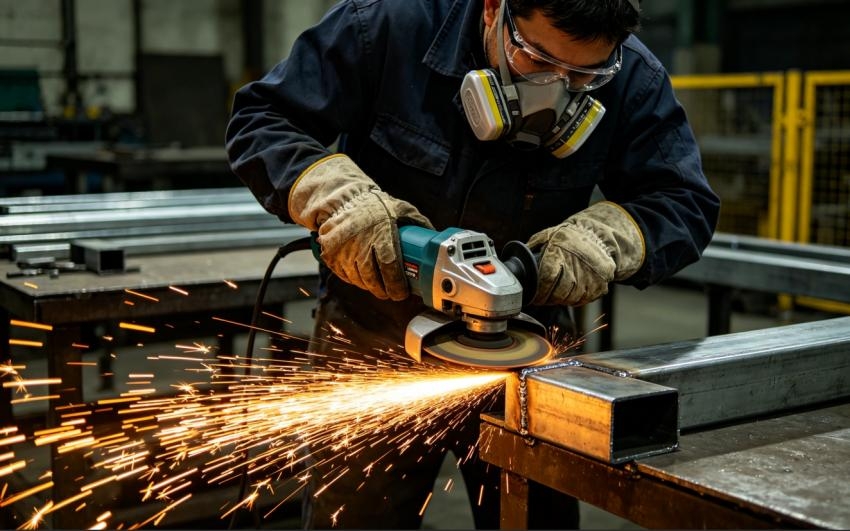
Chamfering Machine vs. Angle Grinder: Key Differences
After reviewing how both tools work, it is clear they serve different jobs in a workshop. Both can bevel metal edges and remove burrs, but their accuracy, safety, efficiency, and cost differ greatly. Choosing the wrong tool often leads to uneven edges, wasted material, extra rework, and safety risks. Here is a quick comparison to help you pick the right one.
| Comparison Item | Chamfering Machine | Angle Grinder |
| Finishing Precision | Fixed preset angles; consistent repeatable chamfers | Manual hand‑driven; inconsistent bevel quality |
| Operation Safety | Low vibration, minimal sparks, no kickback risk | High kickback risk, heavy sparks, slip hazards |
| Working Efficiency & Volume Suitability | Optimized for batch and repeated production | Best for occasional, small‑scale jobs |
| Suitable Materials | Carbon steel, stainless steel, aluminum and alloy metals | Metal, stone, concrete, tile, wood |
| Application Focus | Weld prep, pipe & plate chamfering, deburring | Cutting, rust removal, rough grinding, site repairs |
| Learning Curve | Low; quick setup for new operators | Steep; needs skilled hand control |
| Portability | Portable handheld models plus bench‑mounted variants | Fully handheld, highly mobile |
| Cost Profile | Higher upfront investment, lower rework cost | Low initial purchase cost, higher potential rework |
Bottom line:
If your workshop prioritizes precise bevel geometry, consistent finishing results, improved welding quality, and long-term production efficiency, a dedicated chamfering machine is definitely the better investment. If you only need occasional edge trimming, emergency repairs, and multi-purpose grinding functions, an angle grinder remains the most convenient handheld option.
Chamfering Machine vs. Angle Grinder: Which One Should You Choose?
Metal beveling is an essential step for welding and part finishing, but picking the right tool can be confusing. Both chamfering machines and angle grinders can create metal bevels, yet they serve different workflows, quality standards and job settings. We break down their best use cases to help you figure out which option fits your metalworking projects.
When Should You Choose an Angle Grinder?
Every metal fabrication shop, job site, and DIY garage relies heavily on angle grinders for daily metalworking tasks. As one of the most universal, affordable, and portable power tools in the industry, the angle grinder delivers unmatched flexibility for general metal modification and on-site finishing work. While it cannot compete with the precision and consistency of professional chamfering machines for standardized production, it remains the most practical solution for flexible, low-volume, and emergency edge-finishing jobs. If your workshop workflow matches the following working scenarios, an angle grinder will be your most suitable tool option.
- Quick one-off tasks: Great for on-site emergency trimming and single non-repeating workpieces.
- Multi-purpose versatility: Handles cutting, rust removal, weld cleaning and rough chamfering all in one tool.
- Low-frequency chamfering: Ideal if you only need occasional beveling and want to skip buying dedicated equipment.
- On-site mobility: Lightweight handheld design for outdoor jobs and oversized fixed workpieces.
- Loose tolerance projects: Works for jobs that accept minor variations in bevel angle and surface finish.
- Budget-friendly entry: Low upfront cost for hobbyists and small shops with limited tool budgets.
Keep in mind: manual grinding relies heavily on your steady hand and operating experience. It will inevitably cause inconsistent edges, residual burrs, and extra rework if you pursue uniform, weld-ready bevels for batch production tasks.
When Should You Choose a Chamfering Machine?
Although angle grinders work well for casual edge trimming, manual grinding always comes with unstable precision, inconsistent repeatability, and potential safety issues during long-term metal finishing. A professional chamfering machine is purpose-built to solve these common pain points, delivering standardized, repeatable, and high-quality beveling results that manual tools simply cannot achieve. It optimizes workshop efficiency, reduces human error, and greatly improves finished part quality for formal metal fabrication and welding projects. For professional fabricators, batch production workshops, and quality-sensitive metalworking tasks, a chamfering machine is definitely the smarter long-term investment.
- Batch production stability: Creates identical uniform bevels across dozens or hundreds of workpieces.
- High-grade weld prep: Makes clean, precise burr-free edges that meet industrial welding requirements.
- Reduced waste & rework: Cuts scrap parts and extra labor caused by uneven manual grinding.
- Safer long-hour operation: Less vibration and fewer sparks to lower operator fatigue and hazards.
- Delicate metal processing: Protects aluminum, stainless steel and soft alloys from scratches or gouging.
- Low skill dependency: Novices can produce consistent chamfers without years of grinding practice.
While a chamfering machine carries a slightly higher upfront purchase cost, its stable performance and low rework rate deliver clear savings for long-term commercial production.
Quick Decision Table: Angle Grinder vs Chamfering Machine
After reviewing the full performance differences and applicable scenarios of the two tools, you may still need a straightforward reference to finalize your tool selection. This quick decision table focuses purely on practical job conditions and project demands, without repeating the technical parameters covered in the previous comparison chart. It helps workshop owners, welders, and DIY fabricators make a fast, accurate decision based on real working needs.
| Decision Question | Pick Angle Grinder | Pick Chamfering Machine |
| Core work goal | Multi-task grinding & on-site repairs | Uniform, weld-ready edge beveling |
| Chamfering frequency | Occasional, one-off jobs | Daily, repeated chamfer tasks |
| Workpiece condition | Large fixed, non-movable workpieces | Parts movable to your workbench |
|
Top priority |
Low cost & maximum versatility |
Stable quality & less rework |
|
Key requirement |
Fast on-site adjustments |
Consistent edges across all parts |
|
Accepted trade-off |
Bevel quality depends on operator skill |
Higher upfront equipment cost |
When your project fits both tool types, always prioritize your core demand. Choose an angle grinder if job flexibility, multi-purpose use, and low budget are your main concerns. Select a chamfering machine if consistent precision, reliable weld preparation, and long-term production stability are your top requirements.
Frequently Asked Questions
Q: Can you use an angle grinder to chamfer metal?
A: You can chamfer metal with an angle grinder, but results will depend heavily on operator skill. It works for non‑critical one‑off pieces, yet is not reliable for batch production or welds that demand precise bevel geometry.
Q: Which is faster for chamfering metal?
A: For single, infrequent pieces, an angle grinder can be fast to start. Once you process multiple identical workpieces, a chamfering machine completes each chamfer faster with no post‑process correction.
Q: Can an angle grinder make a precise chamfer?
A: An angle grinder cannot guarantee precise, repeatable chamfer dimensions. Even experienced operators will see angle drift across different parts because everything relies on manual hand positioning.
Q: What is the best tool for metal edge preparation?
A: There is no universal best tool. If precision and consistency are your priority, select a chamfering machine. For general‑purpose rough metal shaping and occasional edge work, stick with an angle grinder. Many professional shops use both tools in their workflow.
Q: Is a chamfering machine worth the investment?
A: A chamfering machine is well worth purchasing for fabricators running regular commercial orders. Hobbyists doing only sporadic metalwork may find that an angle grinder meets their needs.
Q: What angle should you use for a metal chamfer?
A: 45° is the most common chamfer angle for general deburring and assembly. For welding prep, follow your weld procedure specification; common bevel angles range between 30°‑60° depending on material thickness and joint design.
Conclusion
Choosing between a chamfering machine and an angle grinder ultimately comes down to your project scale, work location, and quality standards. An angle grinder is your go-to pick for on-site repairs, occasional one-off metal jobs, and multi-purpose grinding tasks. It delivers great flexibility with a low upfront cost, even though the final bevel quality relies heavily on operator skill. On the other hand, a dedicated chamfering machine shines for batch fabrication and strict weld-prep requirements. It produces repeatable, uniform edges with minimal rework, saving time and material waste for regular chamfering work.
No single tool is universally better. Use the decision table above to match your actual working conditions. If you prioritize speed and versatility for random jobs, stick with an angle grinder. If consistent precision and reliable weld-ready edges are non-negotiable, explore reliable metalworking equipment options at Tool.com to find your ideal machine.