
If you work in metal fabrication, mold making or custom mechanical part production, clean and consistent edge finishing is essential. Sharp burrs, jagged edges and uneven chamfers on steel plates, pipes and mold components cause extra grinding work, safety risks and poor weld prep quality. Many large heavy workpieces cannot be moved easily to bench machines, and portable deburring & chamfering tools solve this problem. These compact handheld units finish edges on-site for oversized parts, small batches, mold frames and hardware, no heavy workpiece relocation needed. However, chamfering machine models vary greatly in adjustable angles, cutting capacity, motor power, voltage, speed and workpiece compatibility. It is simple to buy a machine that is underpowered for heavy tasks or over-specified for light deburring.
This buying guide introduces main chamfering machine types, core specs and critical evaluation factors, helping you select the right model according to your workpieces, processing demands and workshop conditions.
- What Is a Chamfering Machine
- Main Types of Chamfering Machines
- Key Factors to Consider When Choosing a Chamfering Machine
- Final Chamfering Machine Buying Recommendations
- Last Words
- FAQ
What Is a Chamfering Machine
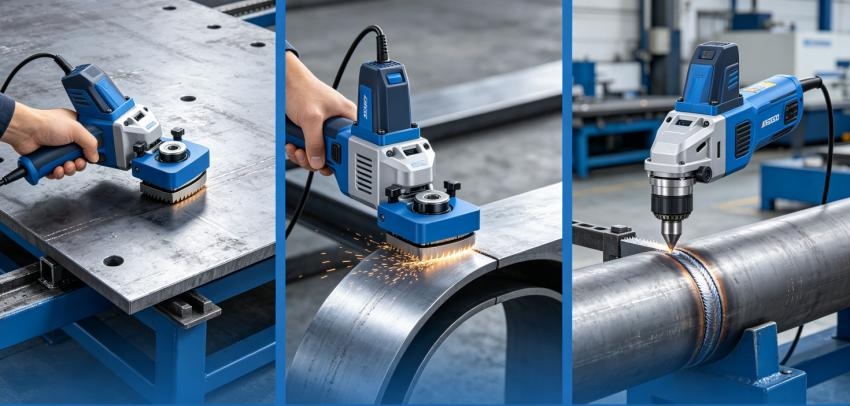
If you’re a metal fabricator, welder, or workshop owner, you know how critical clean, burr-free workpiece edges are for professional metalworking results. After milling, drilling, cutting, or stamping, metal parts always leave behind rough burrs and sharp 90-degree corners. These unpolished edges cause safety hazards, slow down mechanical assembly, weaken welding performance, and ruin the overall finish of your products. This is why a reliable chamfering machine has become standard essential equipment in modern metal fabrication. Simply defined, a electric chamfering machine is a professional edge-finishing tool built to precisely trim metal edges, remove unwanted burrs, and create uniform angled bevels. Unlike angle grinders that deliver random, inconsistent grinding results, it adopts stable milling cutting technology to standardize edge quality without relying on manual experience.
A chamfering machine focuses on two core processing functions: deburring and chamfering. Deburring eliminates sharp residual metal fragments generated during mechanical machining, which otherwise cause assembly errors, operator injuries, and structural stress concentration that shortens part service life. Chamfering smooths sharp right-angle corners into tidy angled transitions to improve part safety, appearance, and assembly compatibility, while customized beveling prepares workpieces for high-quality welding by ensuring sufficient weld penetration and strong, durable joints.
The biggest advantage of using a dedicated chamfering machine is stable precision and consistent finishing quality. Traditional manual grinding often produces uneven edges, over-cutting, and incomplete burr removal, leading to unstable product quality. In contrast, a professional chamfering machine maintains fixed angles and uniform cutting depth on straight edges, plates, and pipe workpieces, effectively solving common edge-finishing problems, improving workshop efficiency, reducing manual labor costs, and ensuring all metal parts meet industrial safety, assembly, and welding standards.
Main Types of Chamfering Machines
Now that you have grasped the core functions and industrial value of chamfering and deburring equipment, it is necessary to categorize mainstream chamfering machines on the market. Each type fits different workshop scales, workpiece types and production modes. Clarifying their core scenarios and pros and cons helps you pick the right edge-finishing tool for your metal fabrication tasks.
Chamfering Machine Types & Applicable Scenarios
The metal fabrication industry features five mainstream chamfering machine types, each designed for exclusive working scenarios:
- Portable Handheld Chamfering Machine: Lightweight and flexible, handheld chamfering machines allow on-site processing without moving bulky workpieces. Ideal for field construction, mold deburring and small-batch custom fabrication, they suit small workshops and daily maintenance tasks. The only downside is fatigue during prolonged manual operation.
- Bench-Mounted Chamfering Machine: Fixed desktop equipment focused on standardized batch processing. It delivers stable precision and consistent chamfer quality for small and medium metal parts, perfect for medium and large factories with fixed production lines. It lacks flexibility and cannot process oversized workpieces.
- Magnetic Chamfering Machine: A ferrous metal-specific tool with a strong magnetic base for stable adsorption on steel plates. It frees hands from long pressing work, specializing in straight-edge chamfering for steel plates and structural steel. It is not compatible with aluminum, copper or non-magnetic stainless steel.
- Pipe & Tube Chamfering Machine: Professionally built for pipe end pre-welding bevelling. It creates smooth, uniform bevels to ensure tight welding joints, widely used in pipeline engineering and pressure vessel manufacturing. It only applies to tubular workpieces, not flat or special-shaped parts.
- CNC Fully Automatic Chamfering Machine: High-end industrial automated equipment with ultra-high precision for large-scale standardized production. It features stable performance but requires high investment and complex debugging, making it only suitable for large industrial factories, not small workshops or on-site operations.
Our Complete Chamfering Machine Product Line
To cover diversified edge-finishing needs from on-site flexible operation to factory batch production, we have launched five core chamfering machine models. Each series is tailored to targeted working scenarios, matching the actual processing demands of European and American fabrication workshops.
- Portable Deburing Chamfering Machine (T-CFM-R2): Our classic portable model supports 15°–45° adjustable chamfering angles and multiple cutting ranges. With optional 250W/750W motors and 2800–6000rpm adjustable speed, it adapts to steel, aluminum and cast iron processing. Lightweight and portable, it is ideal for field work and small-batch custom deburring and trimming tasks.
- Deburing/Chamfering Machine with Mill Cuter (T-CFM-R3): Equipped with professional side milling cutters, this model delivers higher processing precision than ordinary handheld tools. It supports 15°–45° angle adjustment and accurate R/C angle chamfering. Powered by a stable 550W industrial motor and 380V power supply, it fits scenarios requiring high-precision standardized edge finishing.
- Straight & Curve Deburing/Chamfering Machine (T-CFM-R8B): This upgraded dual-purpose model breaks single processing limitations, supporting both straight and curved workpiece chamfering. It adopts independent speed parameters for different surfaces, with a maximum 12000rpm rotating speed for curved parts. It solves the edge-finishing difficulty of special-shaped workpieces, ideal for mold making and customized metal fabrication.
- Semi-Automatic Deburing/ Chamfering Machine (T-CFM-R8H): Designed for factory mass production, this semi-automatic equipment adopts a slide rail positioning structure. With 8000rpm high-speed operation and stable 380V industrial power, it achieves efficient, uniform batch chamfering and deburring, effectively improving workshop production efficiency and product consistency.
- Plate & Pipe Beveling Chamfering Machine (T-CFM-SKF): This multi-functional industrial model supports 30°–60° wide-angle adjustment and a maximum 15mm cutting width, compatible with both plates and pipes. Fitted with a 1.1KW high-power motor and professional milling accessories, it meets high-standard pre-welding edge processing needs for pipelines, structural steel and large metal projects.
Covering flexible on-site tools and high-efficiency factory equipment, our full-range chamfering machines adapt to all common metal edge-finishing scenarios. Browse detailed specs and industry application cases on our chamfering machine product page to find your ideal model.
Key Factors to Consider When Choosing a Chamfering Machine
With this overview of chamfering machine categories and typical applications in mind, we will cover the critical buying criteria next. Picking the wrong model wastes budget, slows workshop workflow and leaves you with inconsistent edge finishes. Before you shop, evaluate these core factors to match the tool to your metalworking tasks.
Material Type
First, confirm the metals you process regularly. Carbon steel works well with most chamfering tools, while stainless steel, aluminum and cast iron demand stronger motor torque and durable cutter heads. Magnetic chamfering units only work on ferrous steel; they cannot grip aluminum or non-magnetic stainless steel. If you switch between multiple materials, pick a versatile handheld or multi-purpose model.
Chamfer Angle & Depth
Check the angle range you need for welding prep or deburring. Most standard jobs use 15°–45° angles, while heavy pipeline projects often require wider angles up to 60°. Also look at maximum cutting depth. Larger depths handle heavy stock removal, but oversized cutting capacity adds unnecessary cost for light deburring work. Match the adjustable range to your standard edge specs.
Size & Mobility
Ask whether you bring parts to the machine or bring the machine to parts. For large, immovable steel plates, molds or pipework, a portable handheld or magnetic chamfering machine is the better choice. If you process batches of small or medium-sized components on a workbench, a bench-mounted or semi-automatic model delivers more consistent results.
Power & Speed
Motor power directly determines cutting performance. Low-power motors suit light deburring on thin sheets. For thick steel and heavy stock removal, choose higher wattage motors to avoid stalling during continuous cutting. Variable speed control is a valuable bonus: slower speeds work for hard metals, while faster speeds deliver cleaner finishes on softer aluminum.
Production Volume
Your daily output decides whether you need a portable single-use tool or a dedicated batch-processing machine. For occasional jobs, repair work and small custom runs, a portable deburring chamfering machine offers great value. If your workshop runs high-volume orders, semi-automatic bench models will boost consistency and cut down manual labor time.
Durability & Spare Parts
For workshop equipment, long-term service life matters. Look for solid cutter heads, stable housings and easily replaceable milling blades. Before purchase, confirm spare parts are in stock locally. Unavailable replacement cutters will halt your production and create costly downtime.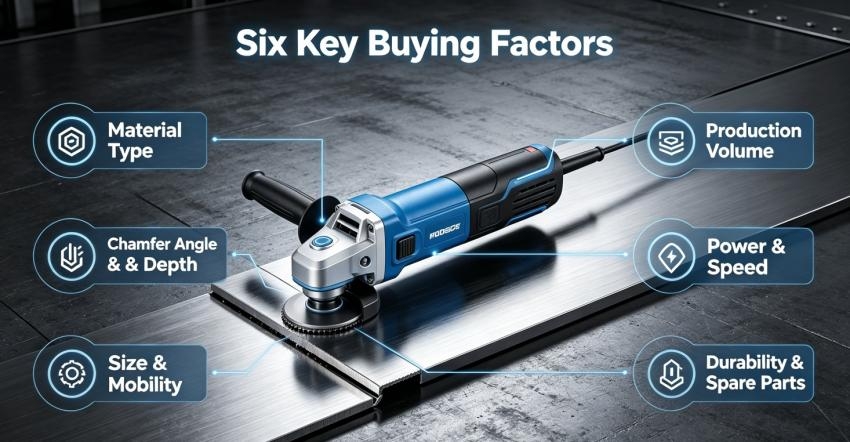
Final Chamfering Machine Buying Recommendations
After breaking down all the critical factors that shape your chamfering machine purchase, you may still feel unsure how to apply these criteria to your unique workshop tasks. Every fabrication shop runs different jobs, from occasional on-site deburring to round-the-clock batch production. The following buying recommendations distill everything we’ve covered, helping you buy the right tool to your workflow and avoid overspending on features you will never use.
Match the machine to your main work
Skip heavy-duty industrial models if you only do occasional field deburring or small custom jobs. A portable handheld chamfering machine works well for on-site repairs and mold trimming. For high-volume batches of small/medium metal parts, semi-automatic units cut manual work and maintain consistent quality.
Choose flexible equipment for mixed jobs
If you process flat steel, curved parts and pipe weld prep, opt for multi-purpose chamfering machines. Our straight & curve dual-purpose and pipe & plate universal models handle different workpieces, so you don’t need multiple single-task machines.
Check spare cutter availability
Cutter heads and milling inserts wear out over time. Confirm replacement parts are easy to source before buying. Hard-to-find cutters lead to costly downtime. Our chamfering machines use standard, readily available cutting accessories.
Verify your workshop power supply
110V/220V portable models suit mobile work and small shops. Production facilities can use stable 380V industrial machines for continuous heavy cutting. Always check your power setup before purchase.
Quick selection guide
- Field work & small batches: Portable Deburring Chamfering Machine
- High-precision mold work: Deburring/Chamfering Machine with Mill Cutter
- Straight + curved workpieces: Straight & Curve Deburring/Chamfering Machine
- Factory mass production: Semi-Automatic Deburring/Chamfering Machine
- Pipe & plate weld prep: Plate & Pipe Beveling Chamfering Machine
Last Words
Choosing the right chamfering and deburring machine simplifies metal edge finishing, cuts manual grinding time and keeps your weld prep consistent. Whether you need portable on-site equipment for small jobs or semi-automatic gear for continuous factory production, matching the machine to your typical workpieces is the key. Take time to check power requirements, cutting range and spare part availability before purchase. If you are interested in our products, you can browse our chamfering machine page for detailed information.
FAQ
Q: What is the difference between chamfering and deburring?
A: Deburring removes sharp metal burrs. Chamfering creates angled edges for weld prep. Our machines support both tasks.
Q: Can handheld chamfering machines process curved parts?
A: Standard handheld models work for straight edges. Select our Straight & Curve Deburring/Chamfering Machine for curved workpieces.
Q: What voltage options do your chamfering machines have?
A: Portable units: 110V/220V. Semi-automatic machines: 380V industrial power.
Q: Are replacement cutter parts easy to obtain?
A: Yes. Standard cutters and inserts are in stock.
Q: Which machine is for pipe and plate weld beveling?
A: Plate & Pipe Beveling Chamfering Machine, max 15mm cutting width.
Q: Do you provide after-sales technical support?
A: Yes, we supply operation guides and technical help.